Baja Knot
Baja
Tying a hook or lure into a fixed loop in heavy mono leader, so the hook swings freely and live bait or a lure can move more naturally.
Finished structure
No drawing of this exact knot yet. The written steps are the reference.
- Diagram in reviewA drawing of the Baja Knot itself is being made. Until then, follow the written steps.
Step 01
Pass the line through the hook eye. Form a large loop several inches from the end of the line and slide the hook down so it hangs freely at the bottom of that loop.
No drawing of this exact knot yet. The written steps are the reference.
You should now seeA large open loop in the line with the hook hanging from its lowest point, and several inches of tag left for the next two loops.
If it goes wrongForming the first loop too close to the end. The second and third loops use up the tag, and stiff heavy mono is hard to handle with a short end.
Fix: Open the loop and form it again further from the end, so several inches of tag are free.
Why: NetKnots describes the Baja as a Perfection Loop with the hook tied into the loop. The hook hangs from a fixed loop instead of being clamped to the line, so a live bait can move more naturally.
- Diagram in reviewA drawing of the Baja Knot itself is being made. Until then, follow the written steps.
Step 02
Run the tag across the front of the first loop and behind the standing line to make a second loop, and pull it much smaller than the first. Repeat to make a third, medium-sized loop.
No drawing of this exact knot yet. The written steps are the reference.
You should now seeThree loops held in your pinch: the large one with the hook, a small one and a medium one, with the tag lying between them and nothing twisted.
If it goes wrongLetting go of the pinch, so the smaller loops twist or cross over each other. The hook then cannot pass cleanly and the knot draws up lopsided.
Fix: Undo back to the first loop and form the second and third again, pinching each one where it crosses the standing line.
Why: The small and medium loops lie around the base of the large loop. When the knot is drawn up they close around it, and that is what stops the hook loop from slipping.
- Diagram in reviewA drawing of the Baja Knot itself is being made. Until then, follow the written steps.
Step 03
Slide the hook to the top of its loop and pass it over the middle loop and under the top loop, then draw the knot up semi-tight.
No drawing of this exact knot yet. The written steps are the reference.
You should now seeThe hook sitting at the top of its loop, the three loops closed partway around it, and the knot starting to take shape above the hook.
If it goes wrongPassing the hook under the middle loop or over the top loop. The knot then slips or comes apart when the standing line is pulled.
Fix: Loosen the loops, back the hook out and pass it again: over the middle loop, then under the top loop.
Why: The hook's path over the middle loop and under the top loop is what locks the finished loop. Drawing up only semi-tight here lets the loops settle evenly before the final pull.
- Diagram in reviewA drawing of the Baja Knot itself is being made. Until then, follow the written steps.
Step 04
Hold the hook with pliers or against a boat rail, pull the standing line hard to set the knot, then trim the tag.
No drawing of this exact knot yet. The written steps are the reference.
You should now seeA fixed loop with the hook hanging from it and a compact knot above that does not move when you pull the standing line hard.
If it goes wrongSetting heavy mono by hand alone. The loops stay partly open and the hook loop can change size under a hard pull.
Fix: If the knot slips or the hook loop changes size under a hard pull, cut it off and tie again.
Why: Heavy mono does not seat under hand pressure alone. Anchoring the hook and pulling the standing line hard closes the loops down, and NetKnots notes the knot does not slip once tightened this way.
Baja Knot — finished-state checks, on the shared reference layout
When this family fails, it fails as these. The recovered end still outranks the name.
A loop that stays the size you made, with a return that cannot cinch.
- !Loop cinched around the hardware — action is dead
- !Return path reversed, so it becomes a slip loop
- !Fluoro in a lock that only behaves on mono
- !Hook passed under the middle loop or over the top loop
- !Drawn only semi-tight, without anchoring the hook and pulling the standing line hard
- !Small loops twisted or crossed, so the knot draws up lopsided
- !Cinched dry, so friction heat weakens the mono
Crossed heavy fluoro wraps that will not dress
Heat and a weak side under a hard run
Baja on stiff fluoro needs even wraps before the set · step 02
Too few wraps for the diameter
Unwraps or heats under load
Heavy fluoro needs the wrap count the diameter asked for · step 01
Sawing dry heavy fluoro on the seat
The line is already glazed
Wet the seat; a dry cinch on stiff fluoro is a retie · step 03
Hook does not hang freely from the finished loop or the knot distorts while seating
Check
- ?Identify the large first loop, smaller second loop, and medium third loop before moving the hook
- ?Confirm the hook goes over the middle loop and under the top loop
Then
- →Retie from the three-loop sequence; do not force a mis-routed knot to seat
Knot body remains loose or creeps when heavy mono is loaded
Check
- ?Finished body is compact
- ?Hook still hangs from a free non-slip loop
- ?No loop in the three-loop structure remains loose
Then
- →Wet the knot and set it firmly with controlled tension
- →Retie if the loop order will not dress compactly
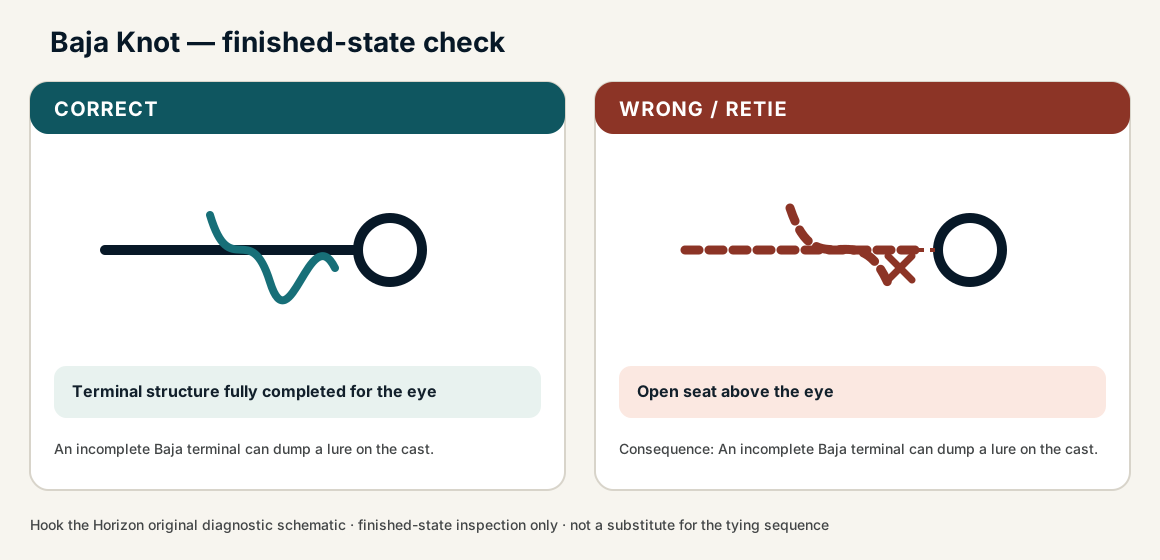
Finished check failed — Open seat above the eye
Check
- ?Terminal structure fully completed for the eye
- ?Seated coil without gaps
- ?Tag controlled
Then
- →Retie. An incomplete Baja terminal can dump a lure on the cast.
Crossed heavy fluoro wraps that will not dress
Check
- ?Heat and a weak side under a hard run
- ?Inspect step 02
Then
- →Retie. Do not dress a defective structure and call it seated.
Too few wraps for the diameter
Check
- ?Unwraps or heats under load
- ?Inspect step 01
Then
- →Retie. Do not dress a defective structure and call it seated.
Sawing dry heavy fluoro on the seat
Check
- ?The line is already glazed
- ?Inspect step 03
Then
- →Retie. Do not dress a defective structure and call it seated.
Same failure class, different geometry. Open the plates — Diagnose still starts from the symptom.
Not ideal for
- ×Light tippet fly work
- ×Tiny eyes