Double Davy Knot
Davy with extra security pass for larger flies.
Beginner · Monofilament / Fluorocarbon
Connection card
Double Davy Knot
For line → hook.
This card does not say how strong the knot is. A retention figure comes from a bench, in one material, at one diameter, tied by somebody who ties it all day — and the line in your hand is none of those. What it does tell you is whether the thing you have just tied is the thing the record describes.
What this plate is telling you
Davy with extra security pass for larger flies.
Save this as a picture and it works with a dead signal and a nearly dead battery, which is when a joint is most often tied badly. The rest of this page — the steps, the seating sequence, the failure modes and the bench — is for the evening before.
Before you start
- ·NetKnots suggests the Double Davy for flies about size 16 and larger, with heavier tippet and larger hook eyes. The single Davy suits flies about size 22 to 18.
- ·On a heavy-wire hook with very light tippet, about 4X to 6X, NetKnots suggests the Orvis knot instead.
- ·Push 8 to 10 cm (3 to 4 in) of tippet through the eye, enough for the overhand and both tucks.
- ·Keep the overhand loose until both tucks are through. A closed loop leaves no room for the second one.
Step 1 of 4. Push 8 to 10 cm (3 to 4 in) of tippet through the hook eye. Take the tag around the standing line and back through its loop to make a loose overhand just ahead of the eye.
No drawing of this exact knot yet. The written steps are the reference.
swipe to step
01
Push 8 to 10 cm (3 to 4 in) of tippet through the hook eye. Take the tag around the standing line and back through its loop to make a loose overhand just ahead of the eye.
A loose overhand in the tippet above the eye, an open loop between the overhand and the eye, and plenty of tag still free.
Pulling the overhand snug. A closed loop has no room for two tucks, and the second one is the first to get skipped.
Fix: Work the overhand open with a fingertip until the loop is clear. If the tag has grown short, pull more through and start again.
Why: Two tucks go through this loop, so it has to stay open until both are in.
- First pass cinched so the second cannot enter — You cannot add the security pass after a hard first seat. Leave the first hitch open enough to take the second pass.
arrow keys work
Tying procedure — Double Davy Knot
- Diagram in reviewA drawing of the Double Davy Knot itself is being made. Until then, follow the written steps.
Step 01 / 4
Push 8 to 10 cm (3 to 4 in) of tippet through the hook eye. Take the tag around the standing line and back through its loop to make a loose overhand just ahead of the eye.
You should now see: A loose overhand in the tippet above the eye, an open loop between the overhand and the eye, and plenty of tag still free.
If it goes wrong: Pulling the overhand snug. A closed loop has no room for two tucks, and the second one is the first to get skipped.
Fix: Work the overhand open with a fingertip until the loop is clear. If the tag has grown short, pull more through and start again.
Why: Two tucks go through this loop, so it has to stay open until both are in.
If wrong: First pass cinched so the second cannot enter — You cannot add the security pass after a hard first seat.
- Diagram in reviewA drawing of the Double Davy Knot itself is being made. Until then, follow the written steps.
Step 02 / 4
Bring the tag back through the loop, passing between the overhand and the hook eye. This is a single Davy so far.
You should now see: The tag comes out between the overhand and the eye, and the loop is still open enough to take another pass.
If it goes wrong: Tucking on the far side of the overhand, or letting this tuck cross over the first turn so the turns stack unevenly.
Fix: Pull the tag back out, lay the turn flat beside the first and tuck again on the eye side of the overhand.
Why: Each turn lies beside the last. A crossed turn makes a lump that stops the knot closing evenly on the eye.
If wrong: Stopped after one pass — That is a Davy — the usual pull-out on a larger fly.
- Diagram in reviewA drawing of the Double Davy Knot itself is being made. Until then, follow the written steps.
Step 03 / 4
Take the tag around the standing line again and pass it through the same loop a second time.
You should now see: Two tucks lying side by side through the loop, both visible before anything is tightened.
If it goes wrong: Stopping after one tuck, or sending the second tuck through a different opening. On a larger fly or heavier tippet, a single Davy can slip.
Fix: Count the tucks before you pull. If only one is there, add the second. If it went through the wrong opening, back it out and retrace it.
Why: NetKnots describes one extra pass through the loop, and also a variant where the second turn goes the same direction instead of reversing. Either gives the tag a second grip on the standing line.
If wrong: Second pass never seated to the eye — Opens under load on anything bigger than a small dry.
- Diagram in reviewA drawing of the Double Davy Knot itself is being made. Until then, follow the written steps.
Step 04 / 4
Pull the tag first to draw the knot up, then pull the standing line to set it on the eye. Trim the tag close.
You should now see: A compact knot on the eye, a little longer than a single Davy, with the tag tucked under it against the eye.
If it goes wrong: Pulling the standing line first, or trimming before the knot is set. Either leaves the tag free to slide out from under the knot.
Fix: Set the knot with the tag and then the standing line before cutting. If the tag has pulled away from the eye, cut the knot off and tie it again.
Why: On light tippet, about 4X to 6X, tied to a large fly, NetKnots suggests the Orvis knot instead. Animated Knots notes that tippet much thinner than the hook wire cannot grip the final tuck well.
Watch the tie
Double Davy Knot | How to Tie the Double Davy KnotAnimatedKnots · Opens on YouTubeExternal video from a creator we follow — not produced by us. Nothing on this page loads from YouTube until you follow the link.
Seating sequence — where failures are born
The step list compresses the finish. Run these phases in order, one at a time.
01 Moisten
Wet the structure before any load reaches it.
Zero. Nothing tightens yet.
02 Load
Take up slack slowly until the wraps begin to gather.
Light and even — both ends moving together.
03 Dress
Watch the wraps stack in order; stop and back off if any cross.
Hold, do not pull. Correction happens here or not at all.
04 Set
One continuous pull to full seat — no sawing, no jerks.
Firm, single direction, standing line against the terminal end.
05 Trim
Cut the tag square, leaving a short stub proud of the knot.
None. Never trim under load.
Finished structure — what correct looks like
No drawing of this exact knot yet. The written steps are the reference.
- ·Terminal wrap stack at eye or along shank
- ·Fully seated to eye or shank
- ·Tag exits clean and short
- ·Even wraps, no crossings
Verify before you load it
Every line is pass or fail. One fail means retie — do not load a knot you argued with.
- 01Terminal wrap stack at eye or along shank
- 02Fully seated to eye or shank
- 03Tag exits clean and short
- 04Even wraps, no crossings
- 05None
- 06double-davy
Field notes — dark, cold, gloves
- ·Retie by feel first, light second — the seat is a tactile event, not a visual one.
- ·Gloves off for the dress phase. Fabric hides a crossing wrap.
- ·Wrong twice in a row means the material or the hardware is fighting you. Change one, not your technique.
Double Davy Knot — finished-state checks, on the shared reference layout
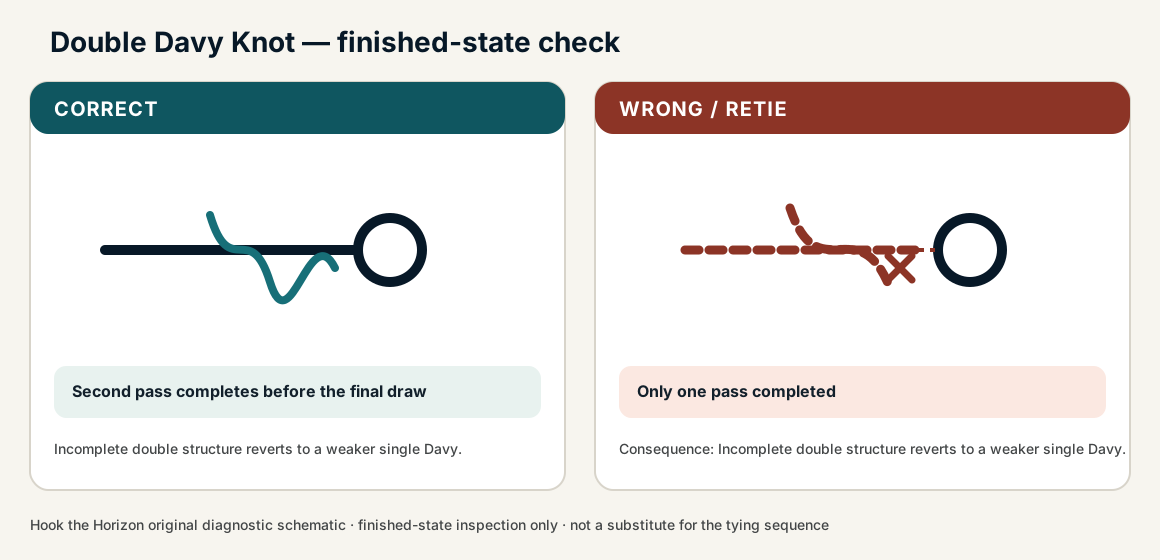
When this family fails, it fails as these. The recovered end still outranks the name.
Fine tippet at the eye, or fly-line to leader with a tube or nail.
- !Hitch path around the eye instead of through it
- !Single pass where two were the job
- !Gap at the tube or nail on a fly-line join
- !Tag end pulled away from the eye, out from under the knot
- !Very light tippet, about 4X to 6X, tied to a heavy-wire hook
- !Only one tuck made on a larger fly or heavier tippet
- !Standing line pulled before the tag, so the tag can slide out
Stopped after one pass
That is a Davy — the usual pull-out on a larger fly
The second pass is why this knot exists · step 02
Second pass never seated to the eye
Opens under load on anything bigger than a small dry
Incomplete second pass is the Double Davy failure · step 03
First pass cinched so the second cannot enter
You cannot add the security pass after a hard first seat
Leave the first hitch open enough to take the second pass · step 01
Opens under load
Check
- ?Both passes visible and tight
Then
- →Retie carefully
Finished check failed — Only one pass completed
Check
- ?Second pass completes before the final draw
- ?Compact seat at the eye
- ?Tag controlled and short
Then
- →Retie. Incomplete double structure reverts to a weaker single Davy.
Stopped after one pass
Check
- ?That is a Davy — the usual pull-out on a larger fly
- ?Inspect step 02
Then
- →Retie. Do not dress a defective structure and call it seated.
Second pass never seated to the eye
Check
- ?Opens under load on anything bigger than a small dry
- ?Inspect step 03
Then
- →Retie. Do not dress a defective structure and call it seated.
First pass cinched so the second cannot enter
Check
- ?You cannot add the security pass after a hard first seat
- ?Inspect step 01
Then
- →Retie. Do not dress a defective structure and call it seated.
Same failure class, different geometry. Open the plates — Diagnose still starts from the symptom.
Get it right with everything in your favour0/5 clean
Good light, dry hands, a table. Until the sequence is automatic here there is nothing for the harder rungs to test — you would only be learning that difficult conditions are difficult, which you already knew.
How · Tie it, check it against the list, log it. Five clean and the ladder opens.
Nothing marked. Log it clean, or mark what happened first.
Not ideal for
- ×Absolute smallest midges where a single Davy is enough
- ×Heavy saltwater terminals and braid
Strength, and where the number comes from
Not established
No published break test, and no source states how much the second pass is worth.
Percentages come from published tests on their own line, their own knot-tyer and their own pull rate. Yours is a different system. Treat a figure as a reason to test, not as a result you already have.
- NetKnots — Double Davy Knot
- FishingKnots.com strength database (Double Davy band)
Recovered from the historical MODEL_SOURCES registry.
- Hook the Horizon — Double Davy
Recovered from the same record’s historical Hook the Horizon resource URL.
Record reviewed 2026-08-13
Vetted references
- Double Davy Knot
Hook the Horizon
- Double Davy Knot | How to Tie the Double Davy Knot
AnimatedKnots
Check the finished knot against what correct looks like before you load it.