Double Davy Knot
Double Davy
Davy with an extra security pass for larger flies or slightly heavier tippet.
Finished structure
No drawing of this exact knot yet. The written steps are the reference.
- Diagram in reviewA drawing of the Double Davy Knot itself is being made. Until then, follow the written steps.
Step 01
Push 8 to 10 cm (3 to 4 in) of tippet through the hook eye. Take the tag around the standing line and back through its loop to make a loose overhand just ahead of the eye.
No drawing of this exact knot yet. The written steps are the reference.
You should now seeA loose overhand in the tippet above the eye, an open loop between the overhand and the eye, and plenty of tag still free.
If it goes wrongPulling the overhand snug. A closed loop has no room for two tucks, and the second one is the first to get skipped.
Fix: Work the overhand open with a fingertip until the loop is clear. If the tag has grown short, pull more through and start again.
Why: Two tucks go through this loop, so it has to stay open until both are in.
- Diagram in reviewA drawing of the Double Davy Knot itself is being made. Until then, follow the written steps.
Step 02
Bring the tag back through the loop, passing between the overhand and the hook eye. This is a single Davy so far.
No drawing of this exact knot yet. The written steps are the reference.
You should now seeThe tag comes out between the overhand and the eye, and the loop is still open enough to take another pass.
If it goes wrongTucking on the far side of the overhand, or letting this tuck cross over the first turn so the turns stack unevenly.
Fix: Pull the tag back out, lay the turn flat beside the first and tuck again on the eye side of the overhand.
Why: Each turn lies beside the last. A crossed turn makes a lump that stops the knot closing evenly on the eye.
- Diagram in reviewA drawing of the Double Davy Knot itself is being made. Until then, follow the written steps.
Step 03
Take the tag around the standing line again and pass it through the same loop a second time.
No drawing of this exact knot yet. The written steps are the reference.
You should now seeTwo tucks lying side by side through the loop, both visible before anything is tightened.
If it goes wrongStopping after one tuck, or sending the second tuck through a different opening. On a larger fly or heavier tippet, a single Davy can slip.
Fix: Count the tucks before you pull. If only one is there, add the second. If it went through the wrong opening, back it out and retrace it.
Why: NetKnots describes one extra pass through the loop, and also a variant where the second turn goes the same direction instead of reversing. Either gives the tag a second grip on the standing line.
- Diagram in reviewA drawing of the Double Davy Knot itself is being made. Until then, follow the written steps.
Step 04
Pull the tag first to draw the knot up, then pull the standing line to set it on the eye. Trim the tag close.
No drawing of this exact knot yet. The written steps are the reference.
You should now seeA compact knot on the eye, a little longer than a single Davy, with the tag tucked under it against the eye.
If it goes wrongPulling the standing line first, or trimming before the knot is set. Either leaves the tag free to slide out from under the knot.
Fix: Set the knot with the tag and then the standing line before cutting. If the tag has pulled away from the eye, cut the knot off and tie it again.
Why: On light tippet, about 4X to 6X, tied to a large fly, NetKnots suggests the Orvis knot instead. Animated Knots notes that tippet much thinner than the hook wire cannot grip the final tuck well.
Double Davy Knot — finished-state checks, on the shared reference layout
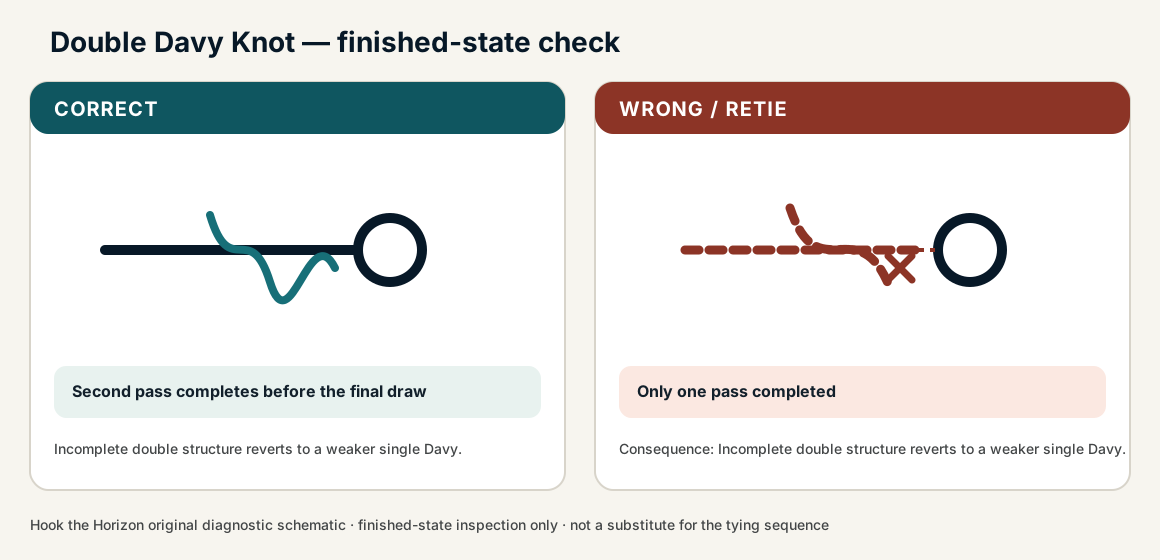
When this family fails, it fails as these. The recovered end still outranks the name.
Fine tippet at the eye, or fly-line to leader with a tube or nail.
- !Hitch path around the eye instead of through it
- !Single pass where two were the job
- !Gap at the tube or nail on a fly-line join
- !Tag end pulled away from the eye, out from under the knot
- !Very light tippet, about 4X to 6X, tied to a heavy-wire hook
- !Only one tuck made on a larger fly or heavier tippet
- !Standing line pulled before the tag, so the tag can slide out
Stopped after one pass
That is a Davy — the usual pull-out on a larger fly
The second pass is why this knot exists · step 02
Second pass never seated to the eye
Opens under load on anything bigger than a small dry
Incomplete second pass is the Double Davy failure · step 03
First pass cinched so the second cannot enter
You cannot add the security pass after a hard first seat
Leave the first hitch open enough to take the second pass · step 01
Opens under load
Check
- ?Both passes visible and tight
Then
- →Retie carefully
Finished check failed — Only one pass completed
Check
- ?Second pass completes before the final draw
- ?Compact seat at the eye
- ?Tag controlled and short
Then
- →Retie. Incomplete double structure reverts to a weaker single Davy.
Stopped after one pass
Check
- ?That is a Davy — the usual pull-out on a larger fly
- ?Inspect step 02
Then
- →Retie. Do not dress a defective structure and call it seated.
Second pass never seated to the eye
Check
- ?Opens under load on anything bigger than a small dry
- ?Inspect step 03
Then
- →Retie. Do not dress a defective structure and call it seated.
First pass cinched so the second cannot enter
Check
- ?You cannot add the security pass after a hard first seat
- ?Inspect step 01
Then
- →Retie. Do not dress a defective structure and call it seated.
Same failure class, different geometry. Open the plates — Diagnose still starts from the symptom.
Not ideal for
- ×Absolute smallest midges where a single Davy is enough
- ×Heavy saltwater terminals and braid