Jansik Special
Jansik knot · Jansik
Tying mono or fluorocarbon line up to about twenty pound test to a hook or lure, with three passes through the eye when the eye has room for them.
Finished structure
Drawn from a rope model of this knot: which strand passes over which comes from where the rope actually lies.
- 1Pass 1, from the standing line2Pass 2, the same way3First circle
Move 1 of 2Run 15 cm of tag through the eye, round in a circle, and through the eye again 1First circle2Second circle, beside it3Pass 3, the same wayMove 2 of 2Make a second circle beside the first and pass the end through the eye a third timeYou should now see: Three passes through the eye, all the same way, and two circles of about the same size side by side. Step 01
Run at least 15 cm (6 in) of line through the eye, bring it round in a circle and through the eye again, then make a second circle beside the first and pass the end through a third time.
You should now seeThree passes of line through the eye and two circles of about the same size lying side by side above it.
If it goes wrongStopping after two passes. There is only one circle, and the wraps in step 3 have less to grip.
Fix: Pass the end through the eye once more to make the second circle before going on.
Why: The three passes spread the load across the eye, and the two circles become part of the bundle the tag wraps around.
- 1Standing line over the circles
Move 1 of 1Bend the standing line up over the two circles and pinch all three togetherYou should now see: The standing line lying across the two circles, three lines side by side in one pinch, none twisted. Step 02
Bend the standing line up and over the two circles and hold the circles and the standing line together, side by side.
You should now seeThe standing line lying across the two circles, giving three lines held in one pinch, with none twisted over another.
If it goes wrongThe two circles twisting around each other or ending up different sizes. The three lines no longer lie flat together in the pinch.
Fix: Loosen the circles, even them up so they lie side by side, then bring the standing line over them again and pinch.
Why: The tag wraps these three lines as one bundle in the next step. Lines lying flat together close evenly, and a twisted circle makes the knot hard to draw up.
- 1Three wraps round all three lines2Third loop
Move 1 of 1Take the tag round in a third loop, then wrap the three lines three timesYou should now see: Three even wraps of tag round both circles and the standing line, side by side and held in place. Step 03
Bring the tag end round in a third loop, then wrap it three times around the three parallel lines, holding the wraps together as you go.
You should now seeThree even wraps of the tag around the two circles and the standing line, lying side by side and held in place.
If it goes wrongWrapping only the standing line, or only the two circles, instead of all three lines. The wraps slide loose when the knot is pulled.
Fix: Unwind the wraps, gather the two circles and the standing line in one pinch, and wrap all three together three times.
Why: Wrapping all three lines binds the two circles to the standing line, so the circles cannot open when the knot is loaded.
Move 1 of 1Wet it, pull hook, standing line and tag three ways, slowly, and trim the tagYou should now see: A compact knot seated evenly at the eye, the circles and wraps drawn down tight, and a short tag. Step 04
Wet the knot. Hold the hook with pliers and pull the pliers, the standing line and the tag end in three directions at once, slowly, until the knot seats. Trim the tag.
You should now seeA compact knot seated evenly at the eye, with the circles and wraps drawn down tight and a short tag.
If it goes wrongPulling only the standing line, or pulling fast. The circles close unevenly and the knot draws up lopsided or stays loose on one side.
Fix: If the knot has closed lopsided, cut it off and tie it again, pulling in all three directions together, slowly, with the knot wet.
Why: The circles, the wraps and the standing line all have to close together, which is why the pull goes three ways. NetKnots suggests the knot for lines up to about twenty pound test.
Jansik Special — finished-state checks, on the shared reference layout
When this family fails, it fails as these. The recovered end still outranks the name.
A compact hitch or jam at the eye — fewer wraps, a different lock than a clinch barrel.
- !Lock never jammed to the eye — it is a loose hitch in disguise
- !Used on a small eye that cannot take the bulk of the jam
- !Confused with a clinch: the tag path is not a barrel tuck
- !Wraps take in only some of the three lines, so they slide loose when the knot is pulled
- !Circles twisted over each other, so the knot will not draw up evenly
- !Pulled tight from the standing line alone or too fast, so it closes lopsided or loose on one side
Twisted triple pass scoring the line
Fails at the eye
Jansik is three clean eye passes, then a lock around the parallel bundle · step 02
Eye too crowded to close
Will not finish — pick another terminal
If the triple pass will not close, the eye is too small · step 01
Tag missed one of the three loops
Unlock — two passes is a different knot
All three loops must be captured in the finish · step 03
Will not close or fails at the eye
Check
- ?Three parallel eye passes
- ?Both loops captured
Then
- →Retie on roomier hardware
- →Use Trilene or Orvis instead
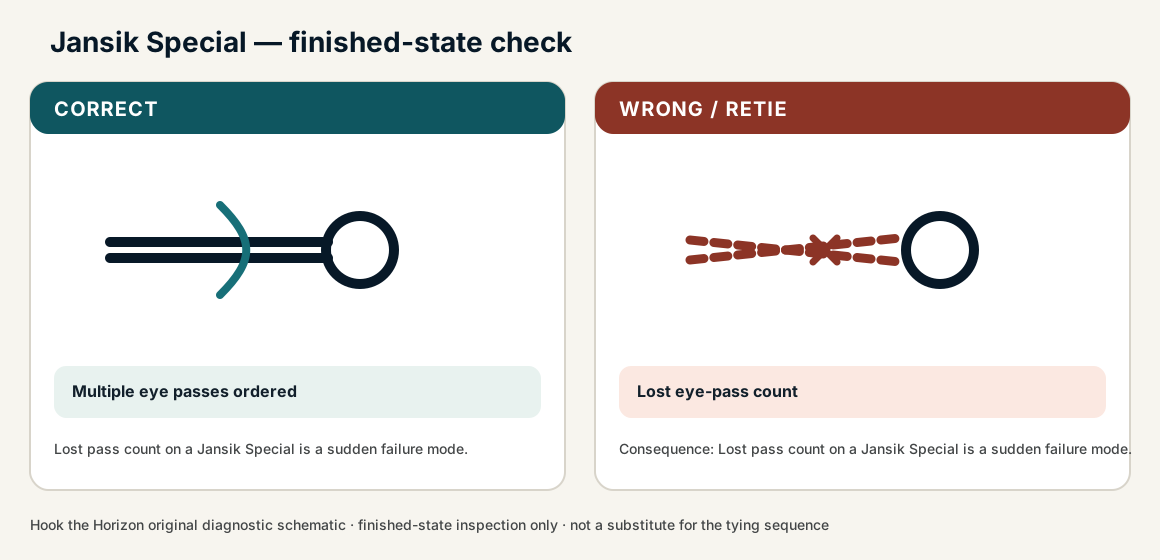
Finished check failed — Lost eye-pass count
Check
- ?Multiple eye passes ordered
- ?Compact final structure
- ?Parallel strands where intended
Then
- →Retie. Lost pass count on a Jansik Special is a sudden failure mode.
Twisted triple pass scoring the line
Check
- ?Fails at the eye
- ?Inspect step 02
Then
- →Retie. Do not dress a defective structure and call it seated.
Eye too crowded to close
Check
- ?Will not finish — pick another terminal
- ?Inspect step 01
Then
- →Retie. Do not dress a defective structure and call it seated.
Tag missed one of the three loops
Check
- ?Unlock — two passes is a different knot
- ?Inspect step 03
Then
- →Retie. Do not dress a defective structure and call it seated.
Same failure class, different geometry. Open the plates — Diagnose still starts from the symptom.
Why this knot
What it earns its place with, what it costs, and what to reach for instead.
- Braid
- Tiny eyes
- Heavy stiff leader that cannot close the compact lock
- Stopping after two passes through the eye, which leaves only one circle
- Circles twisted around each other or made different sizes
- Tag wrapped around the standing line only, or the circles only
- Seating the knot by pulling only the standing line, or pulling fast
- Trilene KnotIntermediate
Tying monofilament or fluorocarbon line to a hook, swivel, snap or lure, with two passes through the eye
- Eye Crosser KnotIntermediate
Snug terminal with doubled eye contact across mono, fluoro, and braid when the hardware has room for two passes
- Orvis KnotBeginner
Ties tippet to a hook or fly with a small knot built on a figure eight