Jack’s Knot
Jacks Knot · Jack Miller knot
Tying a hook or fly to tippet with a small knot of one loop and one wrap, drawn tight up the line and then slid down to the eye.
Finished structure
No drawing of this exact knot yet. The written steps are the reference.
- Diagram in reviewA drawing of the Jack’s Knot itself is being made. Until then, follow the written steps.
Step 01
Run the tippet up through the hook eye, then bring the tag back down alongside the standing line so the two lie parallel.
No drawing of this exact knot yet. The written steps are the reference.
You should now seeThe tag lying back along the standing line to form a double line below the eye, with plenty of tag left to loop and wrap.
If it goes wrongLeaving a short tag. It runs out partway through the wrap and cannot reach back up through the loop.
Fix: Pull more tippet through the eye before forming the loop.
Why: The tag has to form a loop, wrap the double line and come back up through that loop, so it needs to reach well past the double.
- Diagram in reviewA drawing of the Jack’s Knot itself is being made. Until then, follow the written steps.
Step 02
Form a loop with the tag above the doubled line, then take the tag behind the doubled line so it finishes below it.
No drawing of this exact knot yet. The written steps are the reference.
You should now seeOne open loop of tag lying across the doubled line, with the tag passing behind the double and hanging below it.
If it goes wrongTaking the tag in front of the doubled line instead of behind it, or adding a second turn. The loop twists and does not lie flat across the double.
Fix: Undo the loop and form it again with the tag above the double, passing behind it and ending below.
Why: This single loop is what the tag comes back up through in step 3. Its crossing has to run behind the double for that last pass to lock it.
- Diagram in reviewA drawing of the Jack’s Knot itself is being made. Until then, follow the written steps.
Step 03
Working back toward the fly, pass the tag in front of the doubled line and then behind it, then bring it up through the loop you made in step 2.
No drawing of this exact knot yet. The written steps are the reference.
You should now seeThe tag wrapped once around the doubled line below the loop and coming up through that loop, with the loop still open.
If it goes wrongPassing the tag behind first and then in front, or down through the loop instead of up. The tag runs the wrong way and the knot will not draw into a neat shape.
Fix: Back the tag out of the loop and wrap it again, in front first and then behind, before bringing it up through the loop.
Why: Passing in front, then behind, then up through the loop traps the tag under its own wrap. NetKnots splits this into two steps.
- Diagram in reviewA drawing of the Jack’s Knot itself is being made. Until then, follow the written steps.
Step 04
Wet the lines and pull the knot tight first, then slide it down to the hook eye. Trim the tag close to the knot.
No drawing of this exact knot yet. The written steps are the reference.
You should now seeA small, compact knot sitting against the hook eye, centred on the line, with the tag cut short.
If it goes wrongPushing the knot down to the eye while it is still loose, instead of tightening it first. It bunches against the eye and closes out of shape.
Fix: If the knot has closed twisted or out of shape, cut it off and tie it again, tightening it fully before sliding it to the eye.
Why: Drawing the knot tight up the line lets the wraps close evenly. Sliding the finished knot down then seats it against the eye without disturbing them.
Jack’s Knot — finished-state checks, on the shared reference layout
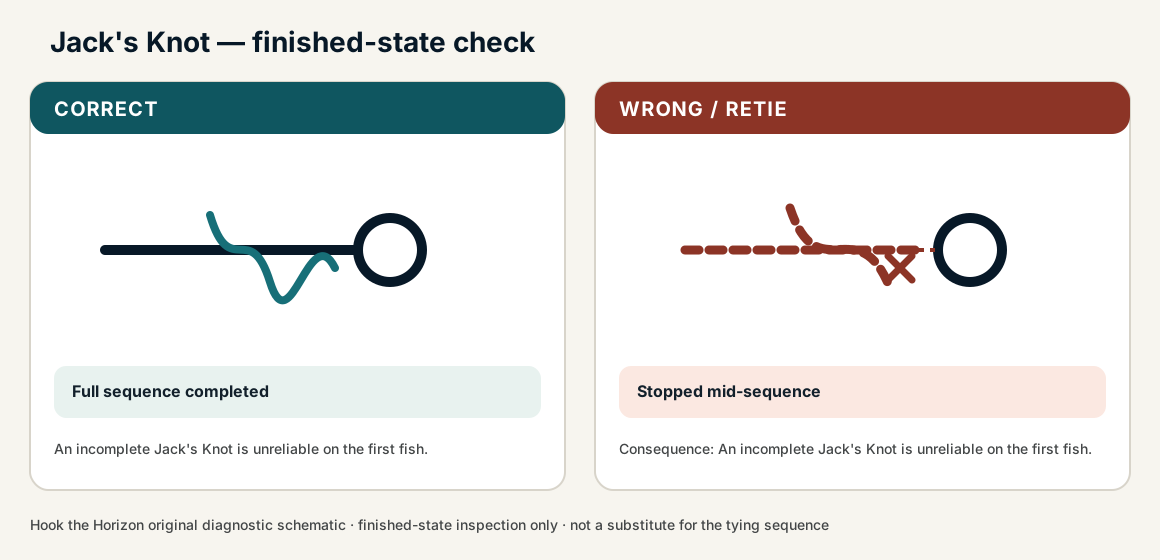
When this family fails, it fails as these. The recovered end still outranks the name.
A compact hitch or jam at the eye — fewer wraps, a different lock than a clinch barrel.
- !Lock never jammed to the eye — it is a loose hitch in disguise
- !Used on a small eye that cannot take the bulk of the jam
- !Confused with a clinch: the tag path is not a barrel tuck
- !Loop crossing runs in front of the double line, so the last pass does not lock it
- !Tag passed down through the loop instead of up, so the knot does not draw into shape
- !Pushed to the eye while still loose, so it bunches and closes out of shape
Reversed crossing
Compact knot twists to one side and slips
Jack’s is a specific crossing, not a random hitch · step 02
Will not seat — wrong side of the crossing
Opens under load
Seat only after the crossing is the Jack’s crossing · step 03
Tag exits the wrong side, or used on braid
Not this knot — braid will not hold this hitch
Tag exit side is the lock; braid is the wrong fibre · step 04
Compact crossing twists to one side or slips
Check
- ?Crossing centered on the standing tippet
Then
- →Retie slowly
- →Step to Orvis or Davy if the crossing will not stay centered
Finished check failed — Stopped mid-sequence
Check
- ?Full sequence completed
- ?Compact seat
- ?Tag controlled
Then
- →Retie. An incomplete Jack's Knot is unreliable on the first fish.
Reversed crossing
Check
- ?Compact knot twists to one side and slips
- ?Inspect step 02
Then
- →Retie. Do not dress a defective structure and call it seated.
Will not seat — wrong side of the crossing
Check
- ?Opens under load
- ?Inspect step 03
Then
- →Retie. Do not dress a defective structure and call it seated.
Tag exits the wrong side, or used on braid
Check
- ?Not this knot — braid will not hold this hitch
- ?Inspect step 04
Then
- →Retie. Do not dress a defective structure and call it seated.
Same failure class, different geometry. Open the plates — Diagnose still starts from the symptom.
Not ideal for
- ×Braid
- ×Heavy conventional tackle
- ×Anyone who inspects Davy/Orvis more reliably