Bimini Twist
High-count twist under tension creates a strong double-line loop for leader systems.
Advanced · Monofilament / Fluorocarbon / Braid
Connection card
Bimini Twist
For line → loop (fixed end loop), double line → leader.
A long doubled section twisted or plaited into a column and locked at the far end.
This card does not say how strong the knot is. A retention figure comes from a bench, in one material, at one diameter, tied by somebody who ties it all day — and the line in your hand is none of those. What it does tell you is whether the thing you have just tied is the thing the record describes.
What this plate is telling you
High-count twist under tension creates a strong double-line loop for leader systems.
Save this as a picture and it works with a dead signal and a nearly dead battery, which is when a joint is most often tied badly. The rest of this page — the steps, the seating sequence, the failure modes and the bench — is for the evening before.
Before you start
- ·Makes a double line with a loop at the end, used for loop-to-loop leader connections or as the double in knots such as the Yucatan.
- ·Start with a long loop and a long tag. The tag has to roll back over every twist and then tie several half hitches.
- ·Tension has to stay on from the twisting to the first half hitch. Slip the loop over a knee, or both knees or feet for a long loop.
- ·NetKnots uses 20 twists; Animated Knots recommends about 30 for mono and more for braid. Put them all in before the tag rolls back.
Step 1 of 4. Double a long length of line into a loop, with a long tag lying beside the standing line.
A long doubled section — this is the whole knot.
A long doubled section — this is the whole knot.
swipe to step
01
Double a long length of line into a loop, with a long tag lying beside the standing line.
A long loop of doubled line, longer than the double you want to finish with, and a tag long enough to roll back over the twists and tie the hitches.
Starting with too short a loop or tag. The loop will not reach over your knee once the twists are in, or the tag runs out before the half hitches.
Fix: Start again with more line doubled. The spare is trimmed off at the end.
Why: The twists use up part of the loop, and the tag has to roll back over every twist and then tie several hitches, so both need extra length.
arrow keys work
Tying procedure — Bimini Twist
step 01 · schematic A long doubled section — this is the whole knot.
Step 01 / 4
Double a long length of line into a loop, with a long tag lying beside the standing line.
You should now see: A long loop of doubled line, longer than the double you want to finish with, and a tag long enough to roll back over the twists and tie the hitches.
If it goes wrong: Starting with too short a loop or tag. The loop will not reach over your knee once the twists are in, or the tag runs out before the half hitches.
Fix: Start again with more line doubled. The spare is trimmed off at the end.
Why: The twists use up part of the loop, and the tag has to roll back over every twist and then tie several hitches, so both need extra length.
step 02 · schematic Twists or plaits into a tight column.
Step 02 / 4
Spin the end of the loop to put at least 20 twists in the doubled line, then slip the loop over your knee and pull the standing line and tag apart to keep the twists tight.
You should now see: A tight, even column of twists running from your hands toward the loop, with the loop held open over your knee.
If it goes wrong: Letting the pull ease while getting the loop over your knee. The twists loosen, bunch up, or leave gaps along the column.
Fix: If gaps appear, take the loop off, untwist it, and put the twists in again before putting tension back on.
Why: NetKnots uses 20 twists. Animated Knots recommends about 30 for mono and more for braid. Put the full count in now, because twists cannot be added once the tag starts rolling back.
If wrong: Loose or gapped twist column — Weak double.
step 03 · schematic Lock at the far end so the column cannot unwind.
Step 03 / 4
Keep the tension on and lower the hand holding the tag until it rolls back over the twists, spreading the loop so the tag wraps down to the end. Lock it with a half hitch around one leg of the loop.
You should now see: The tag wound tightly over the twists in touching turns all the way down to the loop, held there by a single half hitch.
If it goes wrong: Easing the tension or letting go before the half hitch is on. The tag unrolls and the twists spring loose, which shows as the wraps opening up along the column.
Fix: A Bimini that has unwound cannot be patched. Untwist the line and start again from step 2.
Why: Spreading the two legs of the loop is what drives the tag down over the twists. The single half hitch only holds everything while you tie the final lock.
If wrong: Twists unravel — the double is gone — Double-line fails.
step 04 · schematic Column even; lock seated; tags short.
Step 04 / 4
Tie 3 to 5 half hitches with the tag around both legs of the loop, working back toward the knot. Pull them tight against the base of the twists and trim the tag to about 6 mm (a quarter inch).
You should now see: A neat collar of hitches snug against the end of the twists, a short tag, and a loop that keeps its full length when pulled.
If it goes wrong: Too few hitches, or hitches left loose away from the twists. The collar slides and the twists start to unwind when the double is loaded.
Fix: If the tag is still long, add hitches and pull them down tight. If the tag is already trimmed and the collar moves, tie the knot again.
Why: The hitches around both legs stop the tag unrolling from the twists. Working them back toward the knot packs them against the column instead of leaving a gap.
If wrong: Lock hitches never finished the Bimini — Unravels under load.
Watch the tie
How to tie a Bimini TwistStokedOnFishing · Opens on YouTubeExternal video from a creator we follow — not produced by us. Nothing on this page loads from YouTube until you follow the link.
Seating sequence — where failures are born
The step list compresses the finish. Run these phases in order, one at a time.
01 Moisten
Wet the twist column before rollback.
Loop held spread.
02 Load
Maintain spread while feeding twists back.
Constant, both legs equal.
03 Dress
Pack the sleeve down to the base with no voids.
Held.
04 Set
Lock with half hitches, then a finishing hitch.
Firm, on the doubled line.
05 Trim
Trim tag close to the finishing hitch.
None.
Finished structure — what correct looks like
A long doubled section twisted or plaited into a column and locked at the far end.
A long doubled section twisted or plaited into a column and locked at the far end.
This schematic is the family shape, not a drawing of Bimini Twist on its own. The same drawing stands in for Spider Hitch, Australian Plait. Read the steps for what is different.
- ·Long doubled section with dense twist column and locked end
- ·Twists compressed and locked
- ·Locked with half-hitches
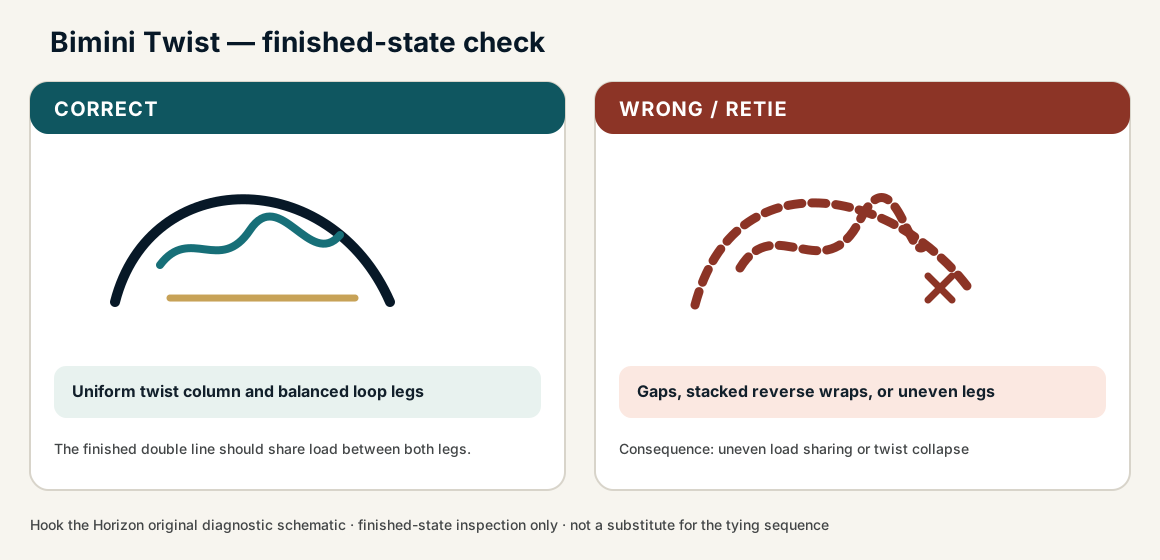
- ·Even twists, no gaps
Verify before you load it
Every line is pass or fail. One fail means retie — do not load a knot you argued with.
- 01Long doubled section with dense twist column and locked end
- 02Twists compressed and locked
- 03Locked with half-hitches
- 04Even twists, no gaps
- 05No loose unravelling
- 06Bimini lock
Field notes — dark, cold, gloves
- ·Tie these before you leave. It is not a knot to attempt in chop.
- ·If the sleeve gaps, cut it off. A gapped Bimini is not a Bimini.
- ·Count aloud. Losing the count is the most common failure.
Bimini Twist — finished-state checks, on the shared reference layout
When this family fails, it fails as these. The recovered end still outranks the name.
Bimini Twist — what fails and what to do
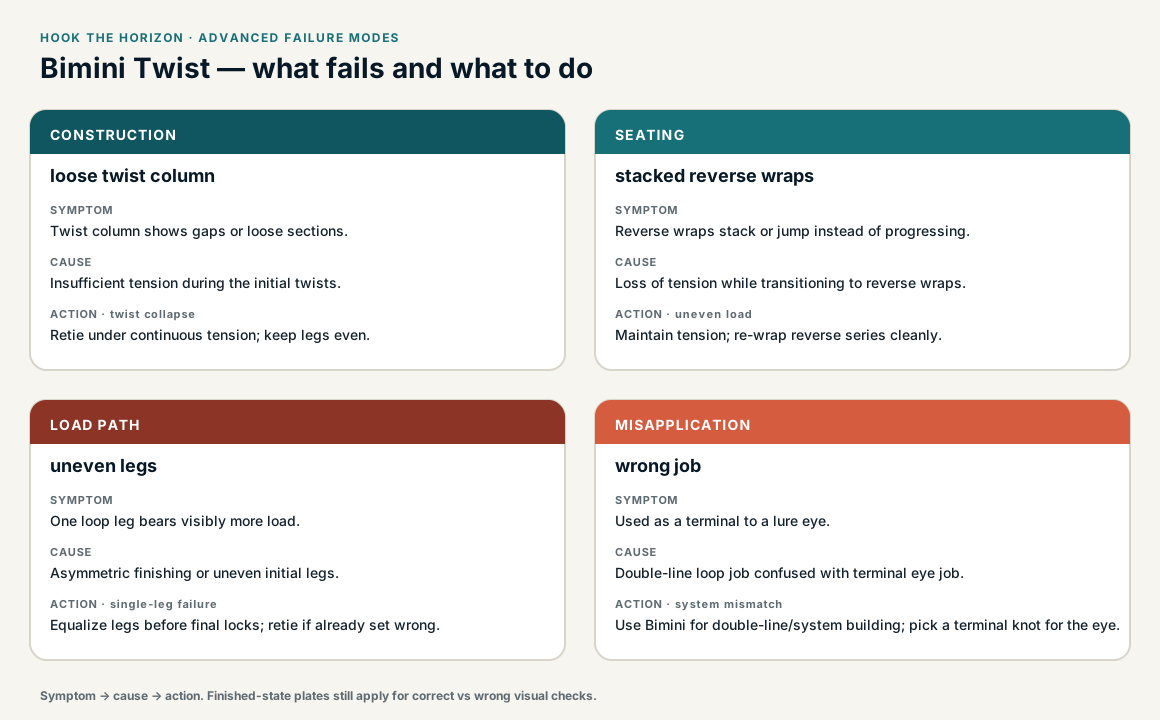
A load-bearing loop of doubled line, locked so it cannot crawl back.
- !Twists or wraps not packed before the lock
- !Lock that crawls back into the double
- !Uneven legs — one side takes the shock
- !Tension eased before the half hitch, so the tag unrolls and the twists spring loose
- !Too few twists. Animated Knots cites tests where about twelve turns failed
- !Locking hitches too few or loose, so the collar slides and the twists unwind under load
- !Hit with sudden jerks while dry, which heats the knot by friction and breaks it at lower loads
Twists unravel — the double is gone
Double-line fails
Tension plus the lock create the Bimini; slack twists dump · step 03
Loose or gapped twist column
Weak double
Dense even twists are the Bimini; gaps are a different structure · step 02
Lock hitches never finished the Bimini
Unravels under load
The end lock is not optional — an unlocked column walks · step 04
Twists unravel before fishing
Check
- ?Inspect twist column density
Then
- →Practice with heavier cord
- →Use a partner for tension
- →Watch a long-form vetted demo
Twist column shows gaps or loose sections.
Check
- ?Look for: Twist column shows gaps or loose sections.
Then
- →Retie under continuous tension; keep legs even.
Reverse wraps stack or jump instead of progressing.
Check
- ?Look for: Reverse wraps stack or jump instead of progressing.
Then
- →Maintain tension; re-wrap reverse series cleanly.
One loop leg bears visibly more load.
Check
- ?Look for: One loop leg bears visibly more load.
Then
- →Equalize legs before final locks; retie if already set wrong.
Used as a terminal to a lure eye.
Check
- ?Look for: Used as a terminal to a lure eye.
Then
- →Use Bimini for double-line/system building; pick a terminal knot for the eye.
Finished check failed — twist column contains loose sections
Check
- ?twist column is uniform under tension
- ?reverse wraps progress without gaps
- ?finished double-line loop has two balanced legs
Then
- →Retie. uneven load sharing or twist collapse.
Twists unravel — the double is gone
Check
- ?Double-line fails
- ?Inspect step 03
Then
- →Retie. Do not dress a defective structure and call it seated.
Loose or gapped twist column
Check
- ?Weak double
- ?Inspect step 02
Then
- →Retie. Do not dress a defective structure and call it seated.
Lock hitches never finished the Bimini
Check
- ?Unravels under load
- ?Inspect step 04
Then
- →Retie. Do not dress a defective structure and call it seated.
Same failure class, different geometry. Open the plates — Diagnose still starts from the symptom.
Get it right with everything in your favour0/5 clean
Good light, dry hands, a table. Until the sequence is automatic here there is nothing for the harder rungs to test — you would only be learning that difficult conditions are difficult, which you already knew.
How · Tie it, check it against the list, log it. Five clean and the ladder opens.
Nothing marked. Log it clean, or mark what happened first.
Not ideal for
- ×Quick bankside re-ties
- ×Beginners without practice gear
Strength, and where the number comes from
90–100% of the weaker line
Measuredpercent of the SINGLE strand's measured unknotted break strength, not of the doubled line the Bimini creates; across 33 entries most Biminis broke between 90 and 100% (one 40-turn knot read 100.9%, above the line's own average break), but the same author's 50-turn Bimini broke at 58%, so turn count and finish dominate
The one knot in the catalogue whose high band survives contact with a laboratory.
The Strongest Double Line Fishing Knot — Sport Fishing (Doug Olander)
Percentages come from published tests on their own line, their own knot-tyer and their own pull rate. Yours is a different system. Treat a figure as a reason to test, not as a result you already have.
- Animated Knots — Bimini Twist
- FishingKnots.com Knot Strength Database
Recovered from this record’s historical modelSourceId registry.
Record reviewed 2026-08-09
Vetted references
- Bimini Twist overview
Animated Knots by Grog
- How to tie a Bimini Twist
StokedOnFishing
Related knots
Check the finished knot against what correct looks like before you load it.