Bimini Twist
Doubled line · Jam
Does not pick a knot
This page does not pick a knot for you. DNA, molecules, quantum braids and vortices stay off Decide.
A long doubled section twisted or plaited into a column and locked at the far end.
Finished structure
A long doubled section twisted or plaited into a column and locked at the far end.
Bimini Twist — finished-state checks, on the shared reference layout
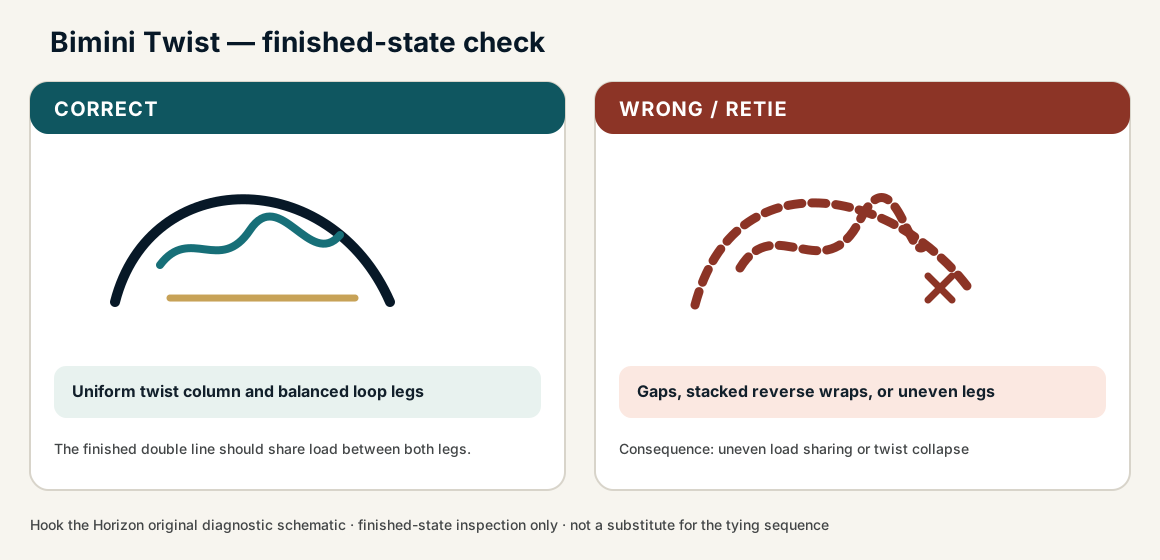
When this family fails, it fails as these. The recovered end still outranks the name.
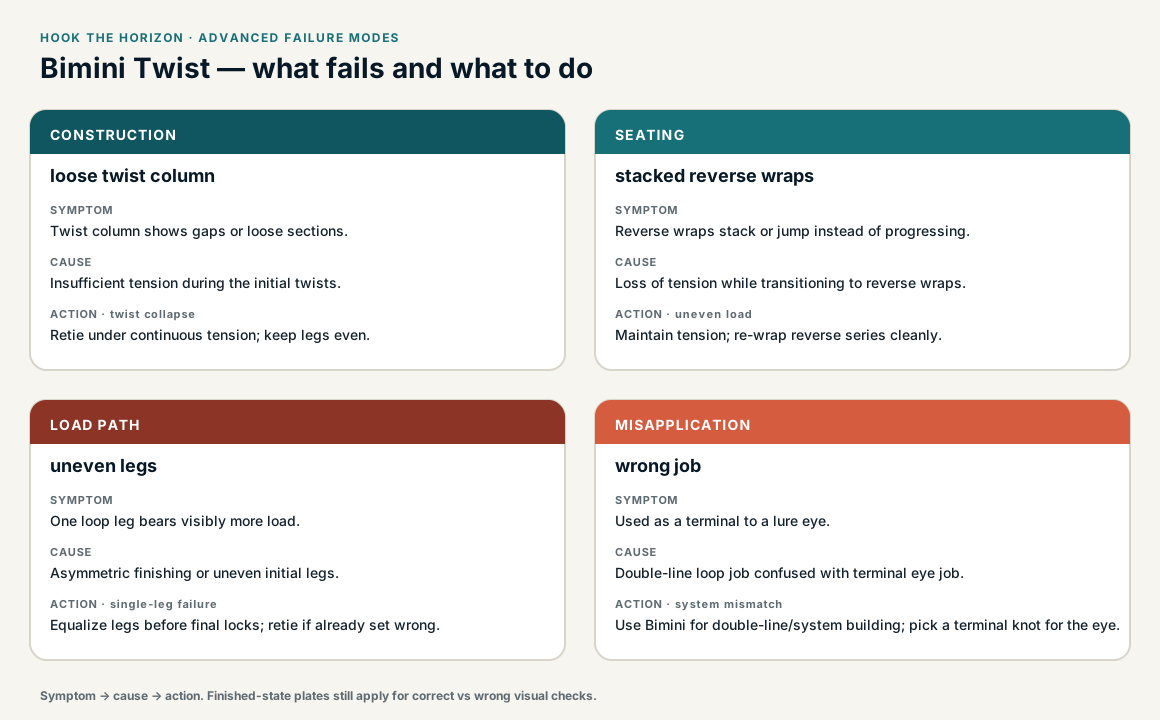
Bimini Twist — what fails and what to do
A load-bearing loop of doubled line, locked so it cannot crawl back.
- !Twists or wraps not packed before the lock
- !Lock that crawls back into the double
- !Uneven legs — one side takes the shock
- !Tension eased before the half hitch, so the tag unrolls and the twists spring loose
- !Too few twists. Animated Knots cites tests where about twelve turns failed
- !Locking hitches too few or loose, so the collar slides and the twists unwind under load
- !Hit with sudden jerks while dry, which heats the knot by friction and breaks it at lower loads
Twists unravel — the double is gone
Double-line fails
Tension plus the lock create the Bimini; slack twists dump · step 03
Loose or gapped twist column
Weak double
Dense even twists are the Bimini; gaps are a different structure · step 02
Lock hitches never finished the Bimini
Unravels under load
The end lock is not optional — an unlocked column walks · step 04
Twists unravel before fishing
Check
- ?Inspect twist column density
Then
- →Practice with heavier cord
- →Use a partner for tension
- →Watch a long-form vetted demo
Twist column shows gaps or loose sections.
Check
- ?Look for: Twist column shows gaps or loose sections.
Then
- →Retie under continuous tension; keep legs even.
Reverse wraps stack or jump instead of progressing.
Check
- ?Look for: Reverse wraps stack or jump instead of progressing.
Then
- →Maintain tension; re-wrap reverse series cleanly.
One loop leg bears visibly more load.
Check
- ?Look for: One loop leg bears visibly more load.
Then
- →Equalize legs before final locks; retie if already set wrong.
Used as a terminal to a lure eye.
Check
- ?Look for: Used as a terminal to a lure eye.
Then
- →Use Bimini for double-line/system building; pick a terminal knot for the eye.
Finished check failed — twist column contains loose sections
Check
- ?twist column is uniform under tension
- ?reverse wraps progress without gaps
- ?finished double-line loop has two balanced legs
Then
- →Retie. uneven load sharing or twist collapse.
Twists unravel — the double is gone
Check
- ?Double-line fails
- ?Inspect step 03
Then
- →Retie. Do not dress a defective structure and call it seated.
Loose or gapped twist column
Check
- ?Weak double
- ?Inspect step 02
Then
- →Retie. Do not dress a defective structure and call it seated.
Lock hitches never finished the Bimini
Check
- ?Unravels under load
- ?Inspect step 04
Then
- →Retie. Do not dress a defective structure and call it seated.
Same failure class, different geometry. Open the plates — Diagnose still starts from the symptom.
What holds it
- ·A double-line is a made pair: twist, hitch or plait, then an end lock. The lock is the knot; the pair is the product.
- ·If the lock opens, you no longer have a double. That is a Diagnose story (double-line unravelled), not a change of mathematical type.
What topology does not predict
- ·Bimini wrap count is a cited procedure, not a Jones degree.
- ·Shock-load behaviour of the pair is material and construction. Unknown stays unknown here.
- ·No IGFA or tournament rule is inferred.
Not for
- ·A single-line terminal to a hook eye
- ·Calling an unlocked plait a finished double
- ·Quick bankside re-ties
- ·Beginners without practice gear
Same pattern, different job
No sourced twin among these knots. Related knots stay on the Library card.
- Knot — practical vs mathematical (Wikipedia) — Closed-curve knot theory ignores friction. Practical knots are classified by function.
- Patil et al. — Topological mechanics of knots and tangles (Science, 2020) — Lab rods: simple topological counts correlate with stability. Not a field rating table.
- Animated Knots — Bimini Twist
- FishingKnots.com Knot Strength Database — Recovered from this record’s historical modelSourceId registry.
- StokedOnFishing — How to tie a Bimini Twist — Cited tying video already attached to this record.