Harvey Dry Fly Knot
George Harvey Dry Fly Knot · Harvey knot
Tying a dry fly with an up-turned or down-turned eye to tippet so the fly does not tilt to one side. No open loop has to pass over a bulky fly.
Finished structure
No drawing of this exact knot yet. The written steps are the reference.
- Diagram in reviewA drawing of the Harvey Dry Fly Knot itself is being made. Until then, follow the written steps.
Step 01
Check that the fly has an up-turned or down-turned eye before you start. On a straight-eye hook, use a different knot.
No drawing of this exact knot yet. The written steps are the reference.
You should now seeSeen from the side, the hook eye bends clearly up or down away from the line of the hook shank.
If it goes wrongJudging the eye from above and starting on a straight-eye fly. Viewed from the side, the eye lines up with the shank.
Fix: Tie on with a knot meant for straight eyes, or change to a fly with a turned eye.
Why: NetKnots lists this knot for up-turned and down-turned eyes and advises against it on straight eyes. The finished knot sits behind the turned eye on the head of the fly.
- Diagram in reviewA drawing of the Harvey Dry Fly Knot itself is being made. Until then, follow the written steps.
Step 02
Push the tag end through the hook eye and bring it back toward the standing line. Make a small loop around the standing line, then a second loop the same size, and hold the two together.
No drawing of this exact knot yet. The written steps are the reference.
You should now seeTwo small loops of the same size lying together around the standing line, pinched so neither one slips.
If it goes wrongMaking the loops different sizes, or letting one slip out of the pinch. The loops no longer lie together and the tag cannot pass cleanly through both.
Fix: Let the loops go and form them again one at a time, matching the second to the first before pinching them together.
Why: The two loops slide back over the eye at the end. Loops of the same size move together and seat as one.
- Diagram in reviewA drawing of the Harvey Dry Fly Knot itself is being made. Until then, follow the written steps.
Step 03
Run the tag end through the two loops twice, making two wraps around them.
No drawing of this exact knot yet. The written steps are the reference.
You should now seeThe tag wrapped twice through both loops, the wraps lying side by side, and the loops still held together.
If it goes wrongPassing the tag through only one loop, or making a single wrap. The knot pulls apart instead of closing when the standing line is pulled.
Fix: Loosen the wraps, check that the tag goes through both loops, and add the second wrap before tightening.
Why: Two wraps through both loops bind them together, so they slide back over the eye as one unit when the standing line is pulled.
- Diagram in reviewA drawing of the Harvey Dry Fly Knot itself is being made. Until then, follow the written steps.
Step 04
Wet the knot. Hold the bend of the hook in one hand and pull the standing line with the other until the loops slide back and pop over the hook eye. Trim the tag.
No drawing of this exact knot yet. The written steps are the reference.
You should now seeThe knot resting behind the eye on the thread wraps at the head of the fly, with the tippet coming straight out of the eye.
If it goes wrongPulling on the tag instead of the standing line, or stopping before the loops pass over the eye. The knot stays in front of the eye and the fly hangs at an angle.
Fix: Hold the hook bend and pull the standing line again until the loops pop over the eye. If they will not go over, cut the knot off and tie it again.
Why: Once the loops pass over the eye, the knot grips the head of the fly behind it. The tippet leaves the eye in a straight line without an open loop passing over a bulky fly.
Harvey Dry Fly Knot — finished-state checks, on the shared reference layout
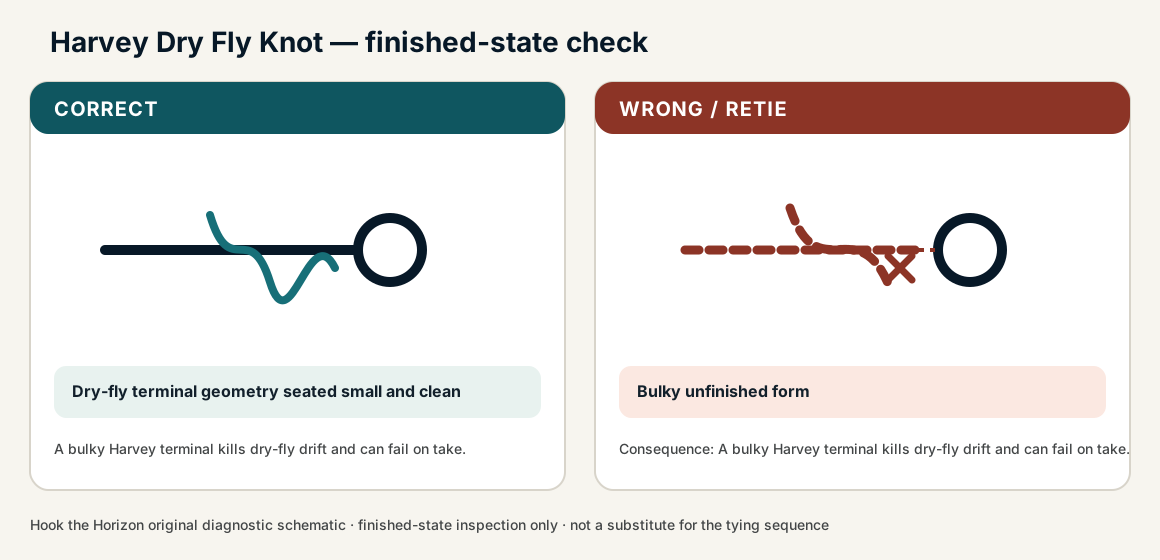
When this family fails, it fails as these. The recovered end still outranks the name.
Fine tippet at the eye, or fly-line to leader with a tube or nail.
- !Hitch path around the eye instead of through it
- !Single pass where two were the job
- !Gap at the tube or nail on a fly-line join
- !Tag passes through only one loop, so the knot pulls apart instead of closing
- !Loops stop in front of the eye instead of popping over it, so the fly hangs at an angle
- !Tied on a straight-eye hook
Loops lost — Turle-shaped mess
Fly pulls nose-down
Harvey holds the dry at an angle with two controlled loops, not a rolled collar · step 02
Used on a straight-eye fly
The knot rolls around the eye; presentation is lost
This family wants a turned-down or turned-up eye · step 01
One pass only on stiff tippet
Will not hold the angle
Stiff tippet on a tiny dry overwhelms a single pass · step 03
Fly pulls nose-down or the knot rolls
Check
- ?Tippet exit angle
- ?Knot parked on the intended side of the eye
Then
- →Retie
- →Switch to Orvis/Davy if presentation angle is not the job
Finished check failed — Bulky unfinished form
Check
- ?Dry-fly terminal geometry seated small and clean
- ?Fly rides true
- ?Tag short and controlled
Then
- →Retie. A bulky Harvey terminal kills dry-fly drift and can fail on take.
Loops lost — Turle-shaped mess
Check
- ?Fly pulls nose-down
- ?Inspect step 02
Then
- →Retie. Do not dress a defective structure and call it seated.
Used on a straight-eye fly
Check
- ?The knot rolls around the eye; presentation is lost
- ?Inspect step 01
Then
- →Retie. Do not dress a defective structure and call it seated.
One pass only on stiff tippet
Check
- ?Will not hold the angle
- ?Inspect step 03
Then
- →Retie. Do not dress a defective structure and call it seated.
Same failure class, different geometry. Open the plates — Diagnose still starts from the symptom.
Not ideal for
- ×Straight-eye flies
- ×Streamers that need free swing
- ×Any job where Davy/Orvis is easier and angle does not matter