Harvey Dry Fly Knot
Friction on hardware
Does not pick a knot
This page does not pick a knot for you. DNA, molecules, quantum braids and vortices stay off Decide.
Finished structure
No drawing of this exact knot yet. The written steps are the reference.
Harvey Dry Fly Knot — finished-state checks, on the shared reference layout
When this family fails, it fails as these. The recovered end still outranks the name.
Fine tippet at the eye, or fly-line to leader with a tube or nail.
- !Hitch path around the eye instead of through it
- !Single pass where two were the job
- !Gap at the tube or nail on a fly-line join
- !Tag passes through only one loop, so the knot pulls apart instead of closing
- !Loops stop in front of the eye instead of popping over it, so the fly hangs at an angle
- !Tied on a straight-eye hook
Loops lost — Turle-shaped mess
Fly pulls nose-down
Harvey holds the dry at an angle with two controlled loops, not a rolled collar · step 02
Used on a straight-eye fly
The knot rolls around the eye; presentation is lost
This family wants a turned-down or turned-up eye · step 01
One pass only on stiff tippet
Will not hold the angle
Stiff tippet on a tiny dry overwhelms a single pass · step 03
Fly pulls nose-down or the knot rolls
Check
- ?Tippet exit angle
- ?Knot parked on the intended side of the eye
Then
- →Retie
- →Switch to Orvis/Davy if presentation angle is not the job
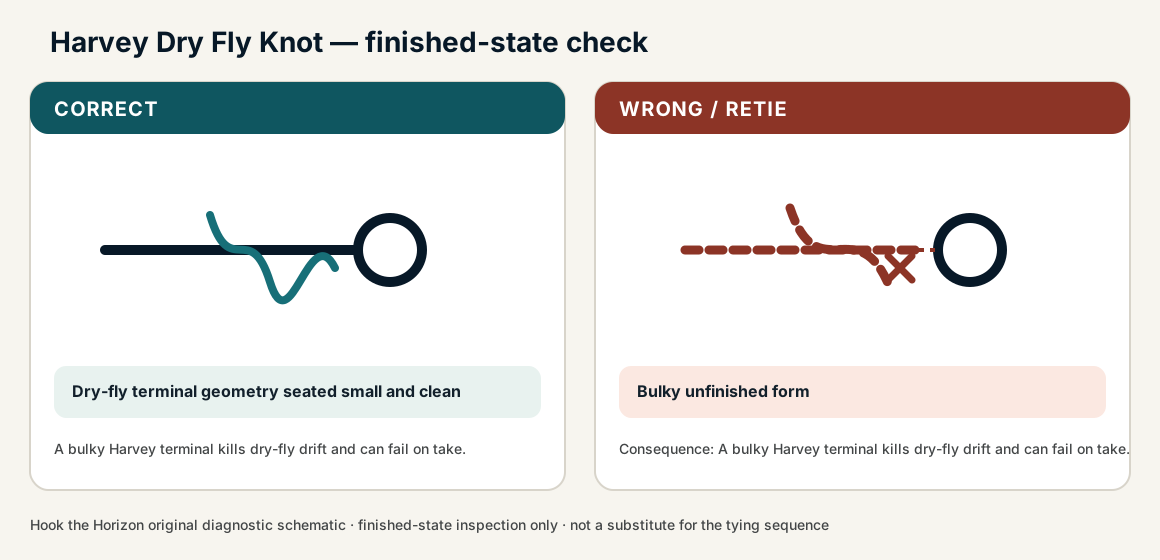
Finished check failed — Bulky unfinished form
Check
- ?Dry-fly terminal geometry seated small and clean
- ?Fly rides true
- ?Tag short and controlled
Then
- →Retie. A bulky Harvey terminal kills dry-fly drift and can fail on take.
Loops lost — Turle-shaped mess
Check
- ?Fly pulls nose-down
- ?Inspect step 02
Then
- →Retie. Do not dress a defective structure and call it seated.
Used on a straight-eye fly
Check
- ?The knot rolls around the eye; presentation is lost
- ?Inspect step 01
Then
- →Retie. Do not dress a defective structure and call it seated.
One pass only on stiff tippet
Check
- ?Will not hold the angle
- ?Inspect step 03
Then
- →Retie. Do not dress a defective structure and call it seated.
Same failure class, different geometry. Open the plates — Diagnose still starts from the symptom.
What holds it
- ·A hitch is object-dependent. Remove the spar, cleat, ring or pile and the structure is usually the unknot.
- ·Bayman / Maddocks–Keller describe a no-slip regime from wrap count and friction. The prediction is approximate, and only for hitches.
What topology does not predict
- ·Closed-loop knot invariants (Jones, Alexander) do not say whether a clove hitch will walk on a smooth spar.
- ·No manufacturer working load is implied by wrap count.
- ·Wet, iced, or HMPE covers change friction — topology is silent.
Not for
- ·Joining two free rope ends — that is a bend
- ·A standing loop that must survive after the object is gone
- ·Straight-eye flies
- ·Streamers that need free swing
Same pattern, different job
No sourced twin among these knots. Related knots stay on the Library card.
- Crowell — The physics of knots (Bayman / Maddocks–Keller) — Bayman 1977 hitch theory; Maddocks & Keller 1987 extension. No equally good general theory for all knots.
- Sano et al. — Inner workings of the clove hitch (Extreme Mechanics Letters, 2022) — Elastic rod on a rigid cylinder. Empirical hitch mechanics.
- Knot — practical vs mathematical (Wikipedia) — Closed-curve knot theory ignores friction. Practical knots are classified by function.
- NetKnots — Harvey Dry Fly Knot
- Hook the Horizon — Harvey Dry Fly Knot — Recovered from the same record’s historical Hook the Horizon resource URL.
- NetKnots fishing knot references — Recovered from this record’s historical modelSourceId registry.
- Take Me Fishing — How to Tie a Harvey Dry Fly Knot | Fishing Knots — Cited tying video already attached to this record.