Homer Rhode Loop Knot
Interlock
Does not pick a knot
This page does not pick a knot for you. DNA, molecules, quantum braids and vortices stay off Decide.
Finished structure
No drawing of this exact knot yet. The written steps are the reference.
Homer Rhode Loop Knot — finished-state checks, on the shared reference layout
When this family fails, it fails as these. The recovered end still outranks the name.
A loop that stays the size you made, with a return that cannot cinch.
- !Loop cinched around the hardware — action is dead
- !Return path reversed, so it becomes a slip loop
- !Fluoro in a lock that only behaves on mono
- !A gap left between the two knots, so the loop can creep larger under load
- !Heavy leader set by hand without pliers, so the knots are not pulled firmly together
- !Second knot tied with crossed turns, so it binds before the knots meet
Too few wraps on heavy leader
Loop walks and cinches
Homer Rhode holds loop size with wraps, not hope · step 02
Loop collapsed while seating
A failed Homer Rhode — not a tight loop
Seat without shrinking the loop; a cinch is a noose · step 03
Loop size set after the wraps
You cannot fix the swing after the barrel is on
Size the loop first · step 01
Loop cinches closed
Check
- ?Loop holds under pull
Then
- →Retie
- →Compare to Non-Slip Mono Loop
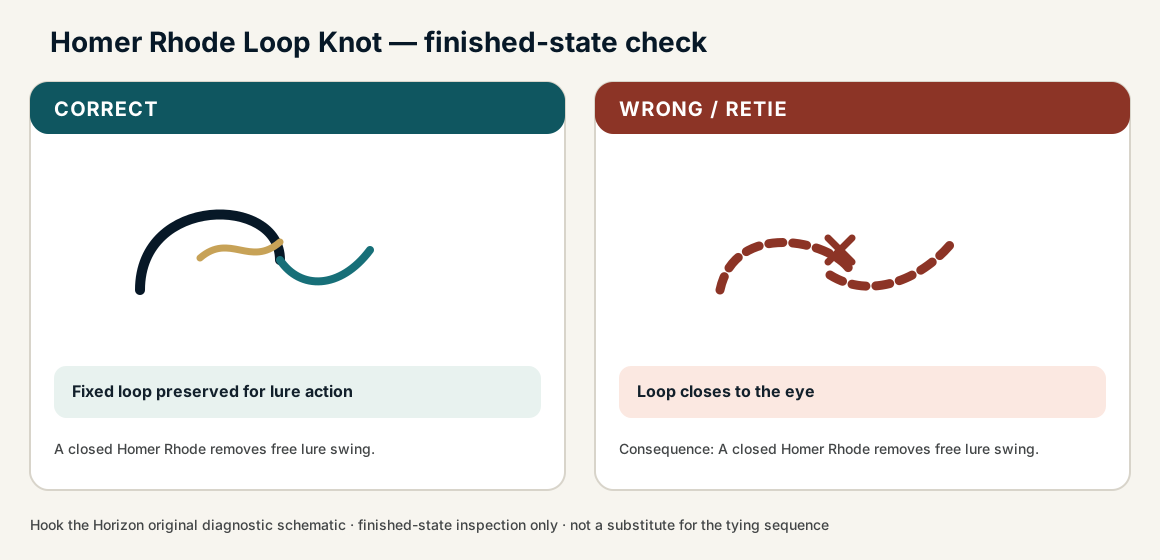
Finished check failed — Loop closes to the eye
Check
- ?Fixed loop preserved for lure action
- ?Wraps ordered on the standing line
- ?Loop does not close under load
Then
- →Retie. A closed Homer Rhode removes free lure swing.
Too few wraps on heavy leader
Check
- ?Loop walks and cinches
- ?Inspect step 02
Then
- →Retie. Do not dress a defective structure and call it seated.
Loop collapsed while seating
Check
- ?A failed Homer Rhode — not a tight loop
- ?Inspect step 03
Then
- →Retie. Do not dress a defective structure and call it seated.
Loop size set after the wraps
Check
- ?You cannot fix the swing after the barrel is on
- ?Inspect step 01
Then
- →Retie. Do not dress a defective structure and call it seated.
Same failure class, different geometry. Open the plates — Diagnose still starts from the symptom.
What holds it
- ·A non-slip lure loop must stay open under a straight pull. Collapse means the return path failed — it is a noose, not a tight loop.
- ·Kreh / Rapala / Homer Rhode families share that job. They are not closed mathematical knots.
What topology does not predict
- ·Loop size is set when you tie. It is not a crossing number.
- ·Free-swing is already one of the things Decide weighs. This page does not change it.
- ·Heavy-leader glaze is material, not topology.
Not for
- ·A standing mid-line loop or a king-sling-style loop in the line
- ·Braid-only terminals where the record already rules the family out
- ·Fine tippet dry-fly work
- ·Maximum slim fixed eye
Same pattern, different job
No sourced twin among these knots. Related knots stay on the Library card.
- Knot — practical vs mathematical (Wikipedia) — Closed-curve knot theory ignores friction. Practical knots are classified by function.
- Patil et al. — Topological mechanics of knots and tangles (Science, 2020) — Lab rods: simple topological counts correlate with stability. Not a field rating table.
- NetKnots — Homer Rhode Loop Knot
- Hook the Horizon — Homer Rhode — Recovered from the same record’s historical Hook the Horizon resource URL.
- Saltwater Experience - Tom Rowland Podcast — Homer Rhode Loop Knot- Heavy Leader- Saltwater Experience — Cited tying video already attached to this record.