Orvis Tippet Knot
Orvis tippet join
Joining tippet to the end of a leader. Both lines pass through one loop twice, and NetKnots calls it quite easy to tie.
Finished structure
No drawing of this exact knot yet. The written steps are the reference.
- Diagram in reviewA drawing of the Orvis Tippet Knot itself is being made. Until then, follow the written steps.
Step 01
Lay the leader and the tippet alongside each other with 10 to 15 cm (4 to 6 in) of overlap.
No drawing of this exact knot yet. The written steps are the reference.
You should now seeLeader and tippet lying parallel and straight through the overlap, with enough of each end past the overlap to hold.
If it goes wrongToo short an overlap. The two passes through the loop use up line, and the leader tag ends up too short to pull on.
Fix: Slide the lines apart and start again with a longer overlap.
Why: Both lines go through the loop twice, which takes more line than a single overhand.
- Diagram in reviewA drawing of the Orvis Tippet Knot itself is being made. Until then, follow the written steps.
Step 02
Pinch both lines between your left thumb and index finger and bring the doubled lines back over themselves to make a loop.
No drawing of this exact knot yet. The written steps are the reference.
You should now seeA loop made of both lines together, held closed at the crossing by your pinch, with the two strands lying flat and untwisted.
If it goes wrongThe two lines separating or twisting around each other inside the loop, so they no longer act as one doubled line.
Fix: Straighten the two lines side by side again and remake the loop, keeping the pinch at the crossing.
Why: The loop has to be formed from both lines together, so that the passes in step 3 trap both of them evenly.
- Diagram in reviewA drawing of the Orvis Tippet Knot itself is being made. Until then, follow the written steps.
Step 03
Wrap both ends behind the doubled line and up above it, then feed the leader tag and the whole tippet through the loop. Repeat for a second pass through the same loop.
No drawing of this exact knot yet. The written steps are the reference.
You should now seeThe leader tag and the tippet have gone through the loop twice, leaving two turns side by side around the doubled line.
If it goes wrongMaking only one pass, or passing the leader tag without the tippet. The knot draws down thin and slips when pulled.
Fix: Back the ends out to the loop and pass both of them through together, twice, before wetting the knot.
Why: The two passes wrap the loop around both lines, and this is where the knot gets its grip.
- Diagram in reviewA drawing of the Orvis Tippet Knot itself is being made. Until then, follow the written steps.
Step 04
Wet the knot and pull on all four ends evenly to tighten. Trim both tags close to the knot.
No drawing of this exact knot yet. The written steps are the reference.
You should now seeA small, even knot with both lines leaving it straight and both tags cut short.
If it goes wrongPulling one side hard before the other, so the knot closes crooked with one line bent sharply through it.
Fix: If the knot has closed crooked, cut it off and tie again, drawing all four ends together.
Why: Wetting reduces heat as the turns close on fine tippet.
Orvis Tippet Knot — finished-state checks, on the shared reference layout
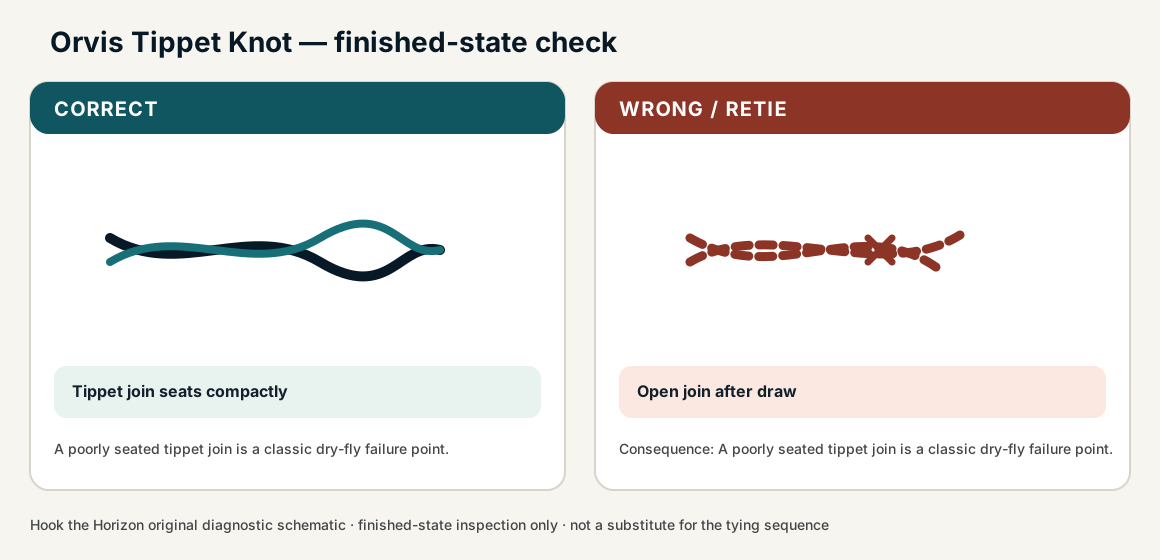
When this family fails, it fails as these. The recovered end still outranks the name.
Symmetric multi-pass join of similar diameters.
- !Unequal wraps or a missed multi-pass
- !Ends not seated together — one side walks
- !Diameter mismatch turning the join into a hinge
- !Only one pass was made through the loop, so the knot draws down thin and slips when pulled
- !The leader tag went through the loop without the tippet, and the knot slips when pulled
- !One side was pulled hard before the other, so the knot closed crooked with one line bent sharply through it
Uneven four-end capture
A hinge that breaks on the first hard take
Orvis tippet is a four-end seat on similar diameters · step 02
Two-end seat left as a twist
Barrel hinges and fails at the join
All four ends must sit in the compact barrel · step 03
Forced a large diameter step-down
Wrong family — this join is similar-diameter only
A large tippet step belongs on a mismatch join · step 01
Breaks at the join under load
Check
- ?Even barrel
- ?Similar diameters
Then
- →Retie wet
- →Match tippet diameter more closely
Finished check failed — Open join after draw
Check
- ?Tippet join seats compactly
- ?Tags exit cleanly
- ?No cutting angle at the junction
Then
- →Retie. A poorly seated tippet join is a classic dry-fly failure point.
Uneven four-end capture
Check
- ?A hinge that breaks on the first hard take
- ?Inspect step 02
Then
- →Retie. Do not dress a defective structure and call it seated.
Two-end seat left as a twist
Check
- ?Barrel hinges and fails at the join
- ?Inspect step 03
Then
- →Retie. Do not dress a defective structure and call it seated.
Forced a large diameter step-down
Check
- ?Wrong family — this join is similar-diameter only
- ?Inspect step 01
Then
- →Retie. Do not dress a defective structure and call it seated.
Same failure class, different geometry. Open the plates — Diagnose still starts from the symptom.
Not ideal for
- ×Extreme diameter jumps
- ×Braid-to-leader primary joins