Surgeon’s Knot
Surgeons knot · Double surgeon’s
Joining a tippet to a leader, including lines of moderately unequal size. The whole tippet passes through the loop on each pass, so it suits a tippet or short section of line.
Finished structure
Drawn from a rope model of this knot: which strand passes over which comes from where the rope actually lies.
- 1Leader's tag end2Tippet's tag end
Move 1 of 1Lay the leader and tippet side by side with a long overlap, ends pointing opposite waysYou should now see: Two lines lying parallel along a long overlap, the leader's tag pointing one way and the tippet's tag the other. Step 01
Lay the end of the tippet alongside the end of the leader, the two ends pointing in opposite directions, so the lines overlap by several inches.
You should now seeTwo lines side by side with a long shared section, the leader tag pointing one way and the tippet end pointing the other.
If it goes wrongToo short an overlap. You notice it at the next step, when there is not enough paired line to form the loop and still make two passes.
Fix: Slide the lines further along each other before you start. The extra overlap only costs tag, which is trimmed off at the end.
Why: The rest of the knot is tied with the two lines handled as one strand, so the overlap is all the working length there is for the loop and both passes.
- 1Loop of both lines
Move 1 of 1Bend both lines together into a loop, as if starting an overhandYou should now see: One loop made of both lines, crossing over the overlap, with the leader's tag and the tippet hanging below the crossing. Step 02
Holding the two lines together as one strand, form a loop in the overlap, as if starting an overhand knot.
You should now seeOne open loop with both lines running around it together, and the leader tag and the whole tippet on the same side, ready to go through.
If it goes wrongLetting the lines separate so only one of them goes around the loop. You see a single strand on part of the loop instead of a matched pair.
Fix: Open the loop, lay the two lines back together along its whole length, and pinch them where they cross.
Why: If one line is left out of the loop, the result is an overhand in one line with the other lying beside it, which does not join them.
Move 1 of 2Pass the leader's tag and the whole tippet through the loop together 1Two passes, both linesMove 2 of 2Take both lines round and through the loop a second timeYou should now see: Two complete passes through the loop, both lines in each, and the loop still open. Step 03
Pass the leader tag and the whole length of the tippet through the loop together, then through the same loop a second time. Make a third pass for a triple surgeon's knot.
You should now seeTwo or three turns of the paired lines wound around each other inside the loop, with the loop still open and nothing pulled tight.
If it goes wrongStopping after one pass, or feeding the lines through separately so one gets a full pass and the other does not. The knot shows a single crossing, or turns that do not match.
Fix: Back the lines out to the first pass and feed both through together again until there are two full passes.
Why: Because the whole tippet has to go through the loop each time, this knot suits a short tippet or leader section. The second pass is what makes it a surgeon's knot rather than a plain overhand.
Move 1 of 2Wet the knot and pull all four ends evenly until it closes Move 2 of 2Trim both tags close to the knotYou should now see: A compact knot with four ends leaving it evenly: the leader and the tippet straight out either side, and two short tag stubs. Step 04
Wet the knot and pull all four ends evenly, a standing line and a tag in each hand, until the knot closes. Then pull the two standing lines apart and trim both tags close.
You should now seeA compact knot with all four ends leaving it evenly and matching turns on both sides. A slight bend where the lines leave the knot is normal.
If it goes wrongSeating the knot on the two standing lines alone. The turns close unevenly, the knot twists out of shape, and a tag can draw back into the body.
Fix: If the knot is only loose, wet it and pull all four ends again. If it has twisted or a tag is buried, cut it out and tie it again.
Why: Pulling all four ends lets the turns close together. Animated Knots notes the finished knot leaves the line at a slight angle, so that bend is how the knot sits rather than a sign of a mistake.
Surgeon’s Knot — finished-state checks, on the shared reference layout
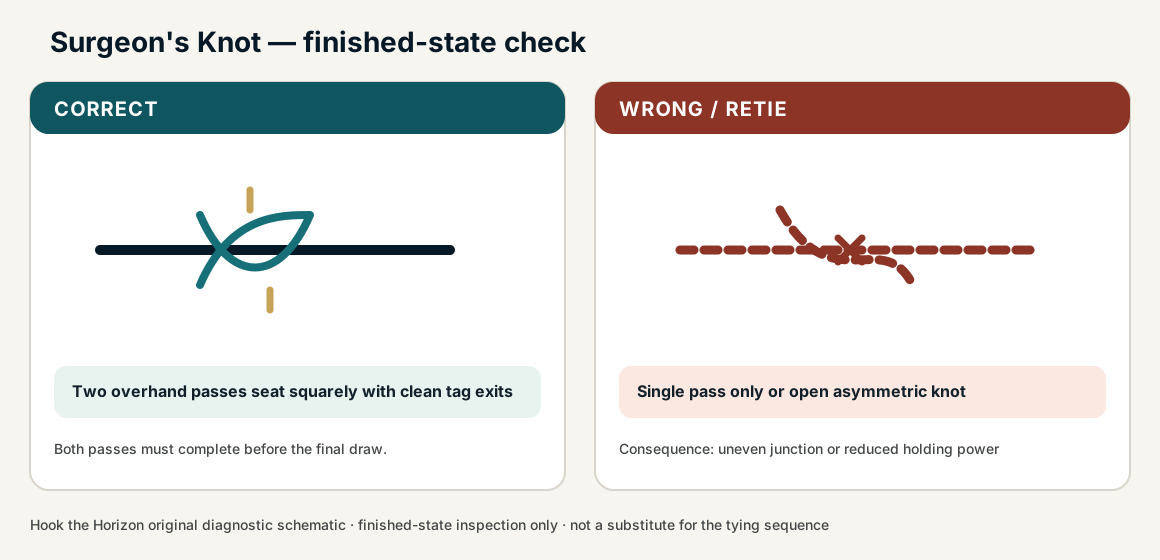
When this family fails, it fails as these. The recovered end still outranks the name.
Surgeon’s Knot — what fails and what to do
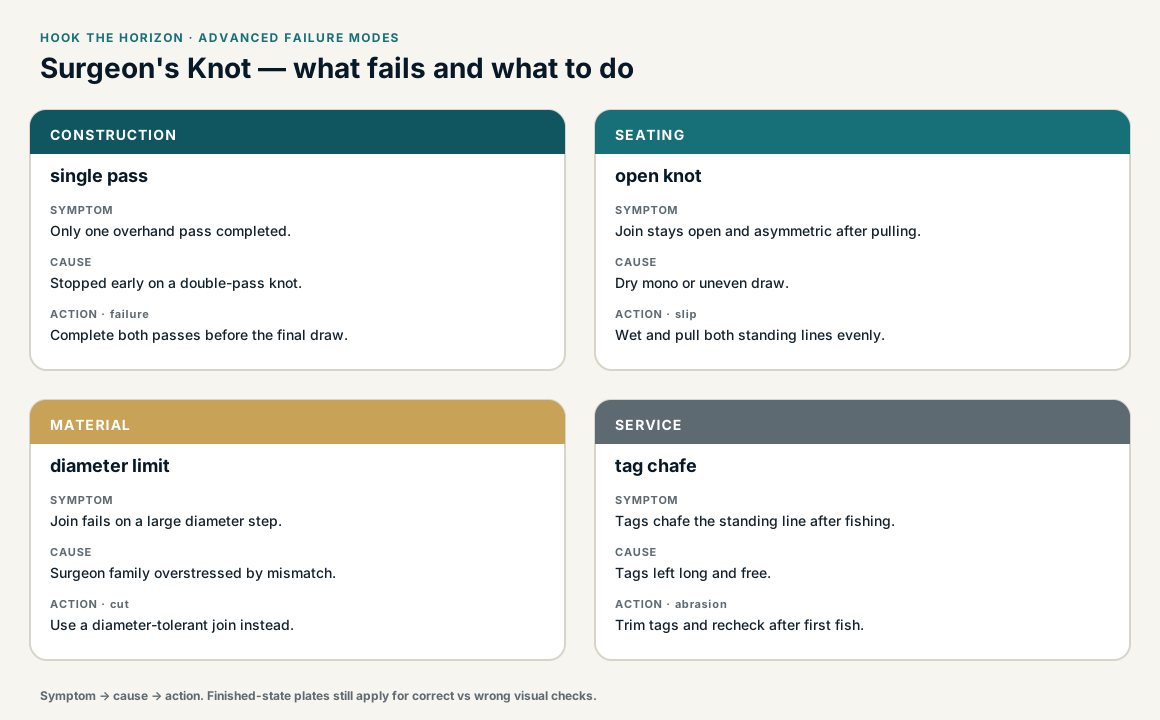
Symmetric multi-pass join of similar diameters.
- !Unequal wraps or a missed multi-pass
- !Ends not seated together — one side walks
- !Diameter mismatch turning the join into a hinge
- !Only one line goes around the loop, leaving an overhand in one line beside the other
- !Stopped after one pass, leaving a plain overhand instead of a surgeon's knot
- !Seated on the standing lines alone, so the turns close unevenly and a tag draws back in
Single overhand — not a Surgeon
Slips on fluoro
Double or triple pass is the security; one pass is a different knot · step 03
Four ends not tensioned evenly
One side loosens and the join walks
A Surgeon is a four-end seat, not a two-end yank · step 04
One of the four ends missed the multi-pass
May slip — the missed end is a hinge
Both tags and both standings must sit in the passes · step 04
Tips not aligned before the passes
A bulky hinge instead of a compact join
Align the overlap first; the lump is expected, the hinge is not · step 04
Slips on slick fluoro
Check
- ?Confirm double or triple pass
Then
- →Use triple surgeon
- →Switch to Blood for similar diameters
Only one overhand pass completed.
Check
- ?Look for: Only one overhand pass completed.
Then
- →Complete both passes before the final draw.
Join stays open and asymmetric after pulling.
Check
- ?Look for: Join stays open and asymmetric after pulling.
Then
- →Wet and pull both standing lines evenly.
Join fails on a large diameter step.
Check
- ?Look for: Join fails on a large diameter step.
Then
- →Use a diameter-tolerant join instead.
Tags chafe the standing line after fishing.
Check
- ?Look for: Tags chafe the standing line after fishing.
Then
- →Trim tags and recheck after first fish.
Finished check failed — only one pass is completed
Check
- ?two overhand passes seat squarely
- ?both tags exit cleanly
- ?finished knot is compact without crossed strands
Then
- →Retie. uneven junction or reduced holding power.
Single overhand — not a Surgeon
Check
- ?Slips on fluoro
- ?Inspect step 03
Then
- →Retie. Do not dress a defective structure and call it seated.
Four ends not tensioned evenly
Check
- ?One side loosens and the join walks
- ?Inspect step 04
Then
- →Retie. Do not dress a defective structure and call it seated.
One of the four ends missed the multi-pass
Check
- ?May slip — the missed end is a hinge
- ?Inspect step 04
Then
- →Retie. Do not dress a defective structure and call it seated.
Same failure class, different geometry. Open the plates — Diagnose still starts from the symptom.
Not ideal for
- ×Situations needing the absolute slimmest barrel
- ×Critical braid-to-leader offshore connections