Arbor Knot
Reel knot · Spool knot
Tying line to the bare arbor of a reel spool before winding it on. The first overhand closes on the arbor like a noose, held by a stopper knot in the tag.
Utility · Beginner · Monofilament / Fluorocarbon / Braid / Backing · 4 steps
ApplicationsHow to tie itLine around the reel arbor; a sliding overhand to the spool and a stopper in the tag.
Finished structure
Line around the reel arbor; a sliding overhand to the spool and a stopper in the tag.
step 01 · schematic Around the arbor so the line cannot slip on a spinning spool.
Step 01
On a spinning reel, open the bail first. Pass the tag end of the line around the arbor of the spool and bring it back out beside the standing line.
Around the arbor so the line cannot slip on a spinning spool.
You should now seeA loop of line around the bare arbor, with the tag and the standing line leaving the spool side by side.
If it goes wrongLine caught outside the bail or around the spool lip instead of the arbor. The loop sits crooked and the knot cannot pull down onto the arbor.
Fix: Unwrap it, open the bail, and lay the line around the arbor itself.
Why: The knot works as a noose around the arbor, so the line has to go round the arbor itself for the noose to close on it.
step 02 · schematic Sliding overhand that will run to the arbor.
Step 02
With the tag end, tie an overhand knot around the standing line.
Sliding overhand that will run to the arbor.
You should now seeA loose overhand in the tag that encircles the standing line and can still slide along it.
If it goes wrongTying the overhand in the tag alone, or around the arbor, instead of around the standing line. When you pull the standing line nothing slides and the loop does not tighten.
Fix: Undo it and tie the overhand again with the standing line running through its middle.
Why: This first overhand is the sliding part of the noose. Leave it loose so it can travel down to the arbor in step 4.
step 03 · schematic Stopper in the tag so the slide cannot come undone.
Step 03
Tie a second overhand knot in the tag end alone, about 2.5 to 5 cm (1 to 2 in) past the first, and pull this one tight.
Stopper in the tag so the slide cannot come undone.
You should now seeA small, hard overhand in the tag a short way past the first knot, while the first knot stays loose on the standing line.
If it goes wrongLeaving the stopper loose, or tying it far out along the tag. It pulls through the first knot or holds it short of the arbor, and the loop stays loose on the spool.
Fix: Untie the stopper and tie it again, pulled tight, closer to the first knot.
Why: The stopper is what the first knot jams against. Animated Knots notes that pulling on the stopper loosens the first knot, which is how the knot is undone later.
step 04 · schematic Cinch to the arbor. Backing should not spin on the spool.
Step 04
Pull the standing line so the first overhand slides down onto the arbor and the stopper jams against it. Trim the tag close.
Cinch to the arbor. Backing should not spin on the spool.
You should now seeBoth overhands butted together against the arbor, and the line does not move around the spool when you hold the spool and pull.
If it goes wrongPulling the tag instead of the standing line, which loosens the first knot. With braid on a smooth bare arbor, the whole loop can turn around the spool even when the knot is tight.
Fix: Pull only the standing line to cinch. If braid turns on the arbor, put a strip of tape or some mono backing on the arbor and tie the knot over it.
Why: Animated Knots also shows taking two or three turns around the arbor before the first overhand, which adds grip on a polished spool.
Arbor Knot — finished-state checks, on the shared reference layout
When this family fails, it fails as these. The recovered end still outranks the name.
A grip on a spool arbor or a lead-core sheath — not a join of equals.
- !Too few turns on a slick arbor
- !Sheath cut while the core is pulled
- !Overhand missing on the leader so the trap never sets
- !No stopper overhand tied in the tag end
- !Stopper left loose, so it pulls through the first overhand
- !Knot not pulled down onto the arbor, leaving the loop loose on the spool
- !Braid on a smooth bare arbor, where the whole loop turns around the spool
Cinch never took the spool arbor
Spool spin / dumped backing
An arbor knot that does not cinch to the spool is not finished · step 03
Missing lock overhand on the tag
May slip around the arbor
The tag overhand is what stops the cinch walking · step 02
Overhands not around the arbor
Unreliable — you tied something else on the spool
Both overhands must capture the arbor path · step 01
Left loose on the arbor
Slip on the first run
Cinch to the spool, then lock; a floating arbor knot dumps · step 03
Whole spool of line spins on the arbor
Check
- ?Pull the line hard and watch for arbor rotation
Then
- →Strip the spool, add tape or a mono underlay, respool under tension
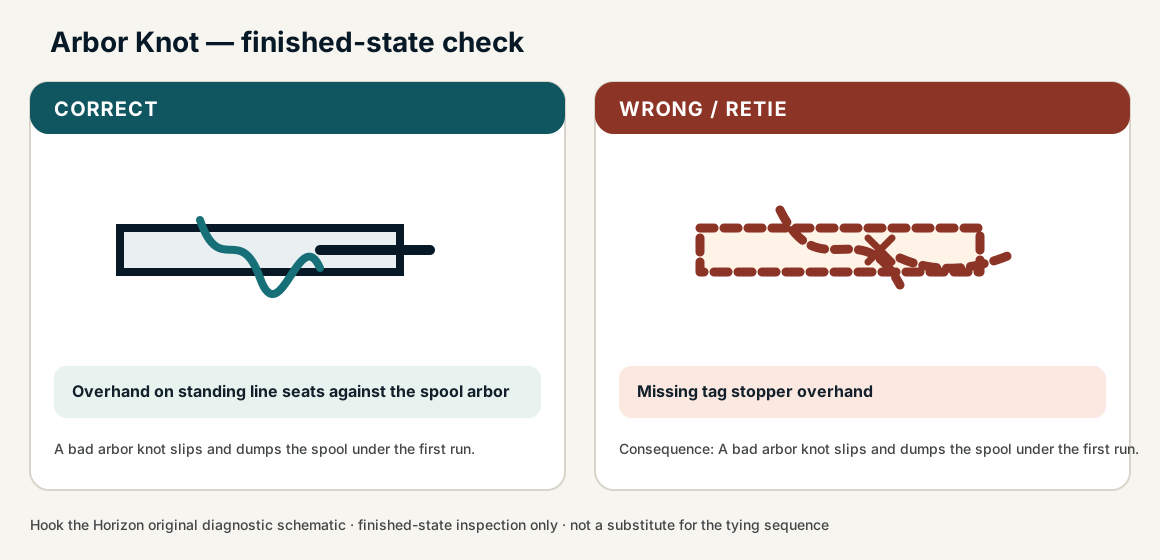
Finished check failed — Missing tag stopper overhand
Check
- ?Overhand on standing line seats against the spool arbor
- ?Tag overhand stops slip under spool tension
- ?Line cinches to the arbor without spinning free
Then
- →Retie. A bad arbor knot slips and dumps the spool under the first run.
Cinch never took the spool arbor
Check
- ?Spool spin / dumped backing
- ?Inspect step 03
Then
- →Retie. Do not dress a defective structure and call it seated.
Missing lock overhand on the tag
Check
- ?May slip around the arbor
- ?Inspect step 02
Then
- →Retie. Do not dress a defective structure and call it seated.
Overhands not around the arbor
Check
- ?Unreliable — you tied something else on the spool
- ?Inspect step 01
Then
- →Retie. Do not dress a defective structure and call it seated.
Same failure class, different geometry. Open the plates — Diagnose still starts from the symptom.
Not ideal for
- ×Any load-bearing terminal or line-to-line job
- ×Backing-to-fly-line — this only grips a spool arbor