Spider Hitch
Doubled line · Jam
Does not pick a knot
This page does not pick a knot for you. DNA, molecules, quantum braids and vortices stay off Decide.
Finished structure
No drawing of this exact knot yet. The written steps are the reference.
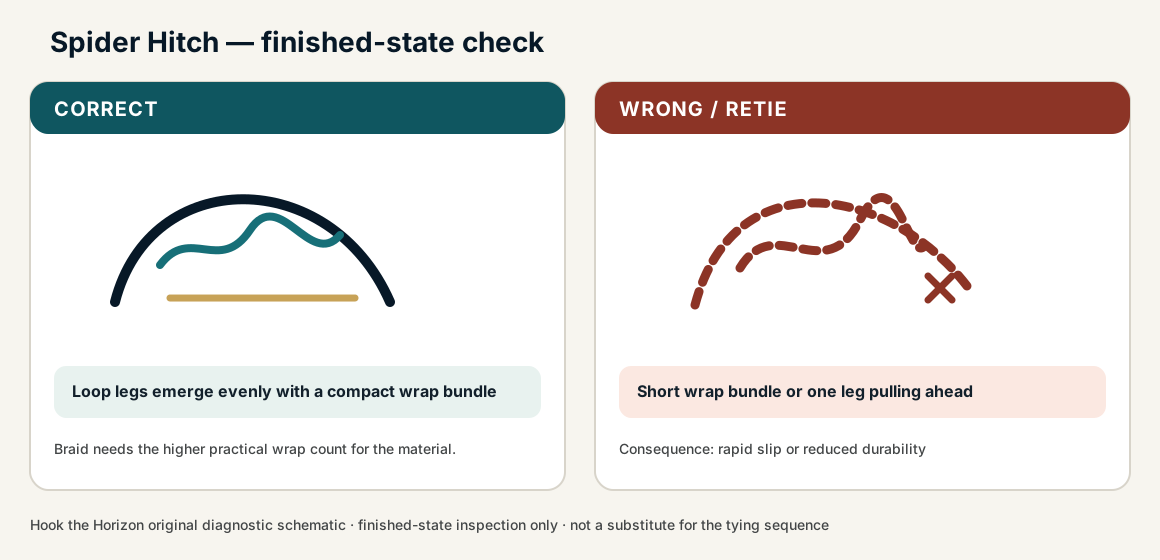
Spider Hitch — finished-state checks, on the shared reference layout
When this family fails, it fails as these. The recovered end still outranks the name.
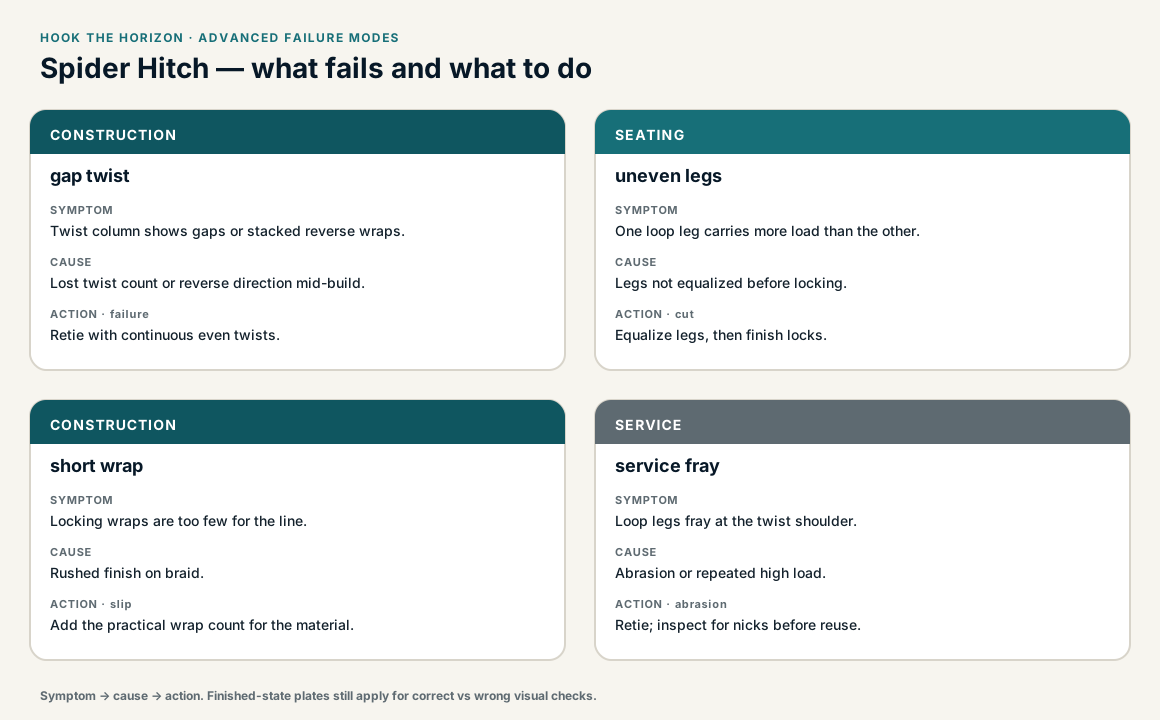
Spider Hitch — what fails and what to do
A load-bearing loop of doubled line, locked so it cannot crawl back.
- !Twists or wraps not packed before the lock
- !Lock that crawls back into the double
- !Uneven legs — one side takes the shock
- !Double taken around the small loop instead of through it, so the hitch falls apart
- !Wraps crossed on the thumb or pulled off together, so they tangle
- !Wraps not closed tight on all four strands, so the double slides open under a hard pull
- !Braid tied with only the 5 wraps given for mono
Hitch column unravels — double is gone
The doubled section fails
Wrap friction under tension holds the Spider; a collapse is a retie · step 03
Under-wrapped or messy hitch column
Weak double you cannot trust on a fish
Even wrap count is the Spider; too few wraps is a different hitch · step 02
Bight never completed the hitch pass-through
Unreliable lock
The loop must complete the hitch before you load the double · step 03
Double unravels or shortens under load
Check
- ?Wrap count
- ?Hitch column density
Then
- →Retie with more wraps
- →Build a Bimini when time allows
Twist column shows gaps or stacked reverse wraps.
Check
- ?Look for: Twist column shows gaps or stacked reverse wraps.
Then
- →Retie with continuous even twists.
One loop leg carries more load than the other.
Check
- ?Look for: One loop leg carries more load than the other.
Then
- →Equalize legs, then finish locks.
Locking wraps are too few for the line.
Check
- ?Look for: Locking wraps are too few for the line.
Then
- →Add the practical wrap count for the material.
Loop legs fray at the twist shoulder.
Check
- ?Look for: Loop legs fray at the twist shoulder.
Then
- →Retie; inspect for nicks before reuse.
Finished check failed — short wrap bundle in slick braid
Check
- ?loop legs emerge evenly
- ?wrap bundle is compact
- ?braid uses the higher practical wrap count required by the material
Then
- →Retie. rapid slip or reduced durability.
Hitch column unravels — double is gone
Check
- ?The doubled section fails
- ?Inspect step 03
Then
- →Retie. Do not dress a defective structure and call it seated.
Under-wrapped or messy hitch column
Check
- ?Weak double you cannot trust on a fish
- ?Inspect step 02
Then
- →Retie. Do not dress a defective structure and call it seated.
Bight never completed the hitch pass-through
Check
- ?Unreliable lock
- ?Inspect step 03
Then
- →Retie. Do not dress a defective structure and call it seated.
Same failure class, different geometry. Open the plates — Diagnose still starts from the symptom.
What holds it
- ·A double-line is a made pair: twist, hitch or plait, then an end lock. The lock is the knot; the pair is the product.
- ·If the lock opens, you no longer have a double. That is a Diagnose story (double-line unravelled), not a change of mathematical type.
What topology does not predict
- ·Bimini wrap count is a cited procedure, not a Jones degree.
- ·Shock-load behaviour of the pair is material and construction. Unknown stays unknown here.
- ·No IGFA or tournament rule is inferred.
Not for
- ·A single-line terminal to a hook eye
- ·Calling an unlocked plait a finished double
- ·Maximum big-game double-line strength (Bimini still preferred when you can build it)
- ·Situations where the hitch can work loose under cyclic load without inspection
Same pattern, different job
No sourced twin among these knots. Related knots stay on the Library card.
- Knot — practical vs mathematical (Wikipedia) — Closed-curve knot theory ignores friction. Practical knots are classified by function.
- Patil et al. — Topological mechanics of knots and tangles (Science, 2020) — Lab rods: simple topological counts correlate with stability. Not a field rating table.
- Take Me Fishing — How to Tie a Spider Hitch Knot
- FishingKnots.com strength database (Spider Hitch band) — Recovered from the historical MODEL_SOURCES registry.
- Salt Strong — Easiest Way To Tie A Spider Hitch Loop Knot — Cited tying video already attached to this record.