NanoFil Knot
Doubled line · Constriction · Wrap stack
Does not pick a knot
This page does not pick a knot for you. DNA, molecules, quantum braids and vortices stay off Decide.
Finished structure
No drawing of this exact knot yet. The written steps are the reference.
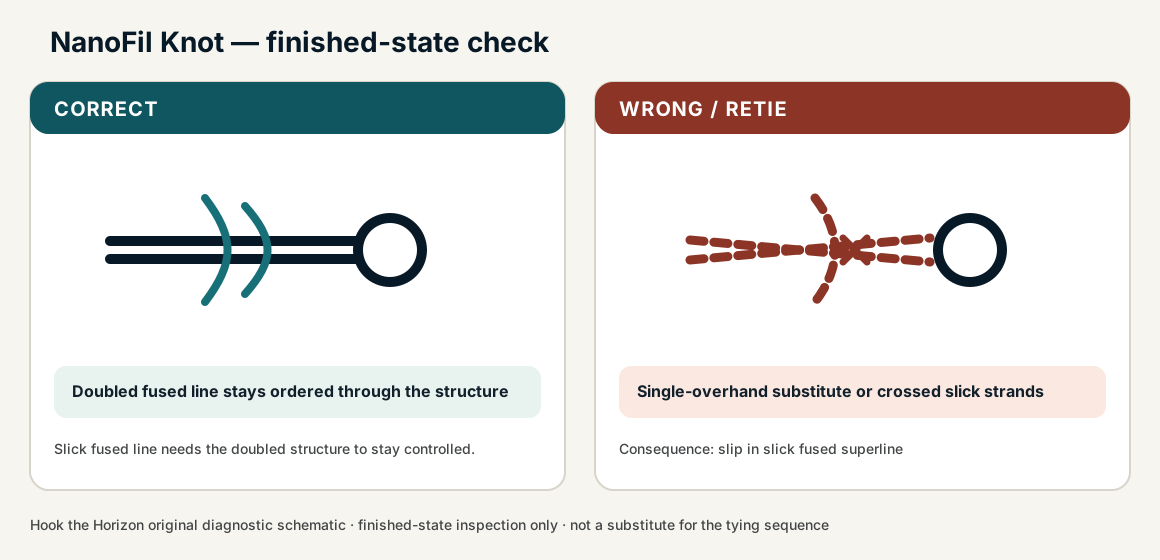
NanoFil Knot — finished-state checks, on the shared reference layout
When this family fails, it fails as these. The recovered end still outranks the name.
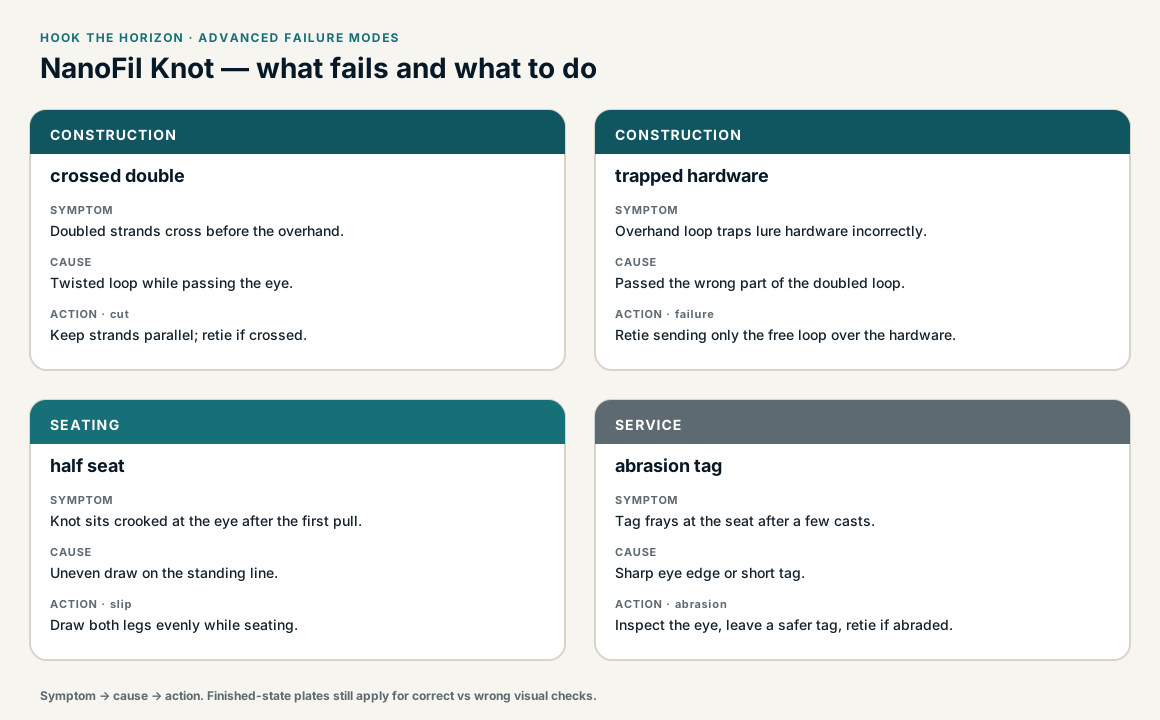
NanoFil Knot — what fails and what to do
Wraps down the standing part, then a tuck that jams the barrel to the eye.
- !Wraps walked or crossed — load on one turn of the barrel
- !Barrel never jammed to the eye, so the tuck is decoration
- !Tag never tucked, or the extra Improved / Trilene pass missing
- !The loop caught on the shank below the eye, so the knot set partly down the shank with one side of the loop longer than the other
- !Only one pass went through the overhand, leaving a plain Palomar without the second turn's extra grip on slick line
- !The second pass took a different opening, so the strands cross and bed unevenly instead of lying as two parallel turns
- !The knot creeps under a hard test pull on slick fused line
Crossed doubled NanoFil in the eye
Walks like a failed Palomar
NanoFil wants the double Palomar path, not a single overhand · step 02
Single Palomar used on NanoFil
Will slip — that is the wrong knot for this fibre
The extra pass is why the NanoFil knot exists · step 03
Hardware caught in the large loop
Cinch traps the lure; structure never forms
Keep the hook/lure out of the tying loop until the passes are in · step 02
Walks under load like a failed Palomar
Check
- ?Two overhand passes visible
- ?Compact seat at the eye
Then
- →Retie the double Palomar
- →Do not fish a single Palomar on NanoFil
Doubled strands cross before the overhand.
Check
- ?Look for: Doubled strands cross before the overhand.
Then
- →Keep strands parallel; retie if crossed.
Overhand loop traps lure hardware incorrectly.
Check
- ?Look for: Overhand loop traps lure hardware incorrectly.
Then
- →Retie sending only the free loop over the hardware.
Knot sits crooked at the eye after the first pull.
Check
- ?Look for: Knot sits crooked at the eye after the first pull.
Then
- →Draw both legs evenly while seating.
Tag frays at the seat after a few casts.
Check
- ?Look for: Tag frays at the seat after a few casts.
Then
- →Inspect the eye, leave a safer tag, retie if abraded.
Finished check failed — ordinary single-overhand Palomar is substituted
Check
- ?fused line remains doubled through the Palomar-style structure
- ?double-overhand section is clean
- ?hardware passes through the loop without twisting the doubled strands
Then
- →Retie. slip in slick fused superline.
Crossed doubled NanoFil in the eye
Check
- ?Walks like a failed Palomar
- ?Inspect step 02
Then
- →Retie. Do not dress a defective structure and call it seated.
Single Palomar used on NanoFil
Check
- ?Will slip — that is the wrong knot for this fibre
- ?Inspect step 03
Then
- →Retie. Do not dress a defective structure and call it seated.
Hardware caught in the large loop
Check
- ?Cinch traps the lure; structure never forms
- ?Inspect step 02
Then
- →Retie. Do not dress a defective structure and call it seated.
Same failure class, different geometry. Open the plates — Diagnose still starts from the symptom.
What holds it
- ·The eye is hardware. The knot is an open tangle around that eye. Ends stay ends.
- ·Seating (wet set, even wraps, tag orientation) is the mechanical record already on the knot. Theory adds no extra rating.
What topology does not predict
- ·Trefoil / unknot classification does not apply to a Palomar or clinch.
- ·Fluoro glaze, pigtail slip and nick-at-the-guides are forensic, not topological.
- ·No strength percentage is computed here.
Not for
- ·A free-swing lure loop — use a non-slip loop family
- ·Using an invariant as a reason to keep a glazed terminal
- ·When the manufacturer of a different line specifies another knot
- ·Tiny eyes that will not take doubled fused line
Same pattern, different job
No sourced twin among these knots. Related knots stay on the Library card.
- Knot — practical vs mathematical (Wikipedia) — Closed-curve knot theory ignores friction. Practical knots are classified by function.
- Patil et al. — Topological mechanics of knots and tangles (Science, 2020) — Lab rods: simple topological counts correlate with stability. Not a field rating table.
- NetKnots — NanoFil / Double Palomar
- Hook the Horizon — NanoFil Knot — Recovered from the same record’s historical Hook the Horizon resource URL.
- NetKnots fishing knot references — Recovered from this record’s historical modelSourceId registry.
- Scott Turnage Unplugged — Best knot for tying Berkley NanoFil — Cited tying video already attached to this record.