J Knot
Wrap stack · Constriction
Does not pick a knot
This page does not pick a knot for you. DNA, molecules, quantum braids and vortices stay off Decide.
Finished structure
No drawing of this exact knot yet. The written steps are the reference.
J Knot — finished-state checks, on the shared reference layout
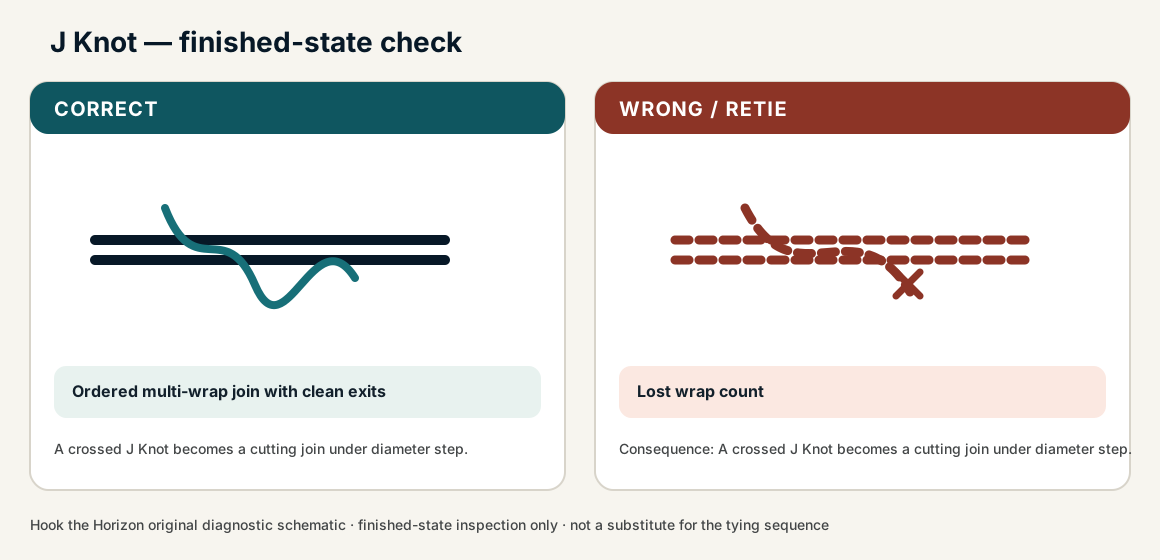
When this family fails, it fails as these. The recovered end still outranks the name.
Bight in the heavier leader; lighter line wraps the bight, then tucks.
- !Bight in the lighter line — the wraps have nothing to bite
- !Wraps walked off the bight instead of packed against the fold
- !Tag never tucked back through the bight, so the wraps dump
- !Lines crossed inside the overhand, so one line takes more of the load
- !Drawn up dry, which heats the line where it seats and weakens it
- !Only the standing lines pulled, leaving one side of the knot loose
- !Tied in braid, which Cast and Spear says may slip
Incomplete passes through the join
The usual J-Knot break at the tippet
Every pass is load-bearing; one missed pass is a hinge · step 02
Tippet step too large for this family
Fails at the join under the first hard take
J-Knot is a modest step, not an extreme mismatch · step 01
Dry fluoro seat
Glazed tippet at the join
Seat wet; an incomplete pass plus heat is a double fail · step 03
Fails at the tippet join
Check
- ?Even seat
- ?Diameter ratio
Then
- →Retie
- →Reduce tippet step
Finished check failed — Lost wrap count
Check
- ?Ordered multi-wrap join with clean exits
- ?Junction stays slim after seating
- ?No reverse wraps
Then
- →Retie. A crossed J Knot becomes a cutting join under diameter step.
Incomplete passes through the join
Check
- ?The usual J-Knot break at the tippet
- ?Inspect step 02
Then
- →Retie. Do not dress a defective structure and call it seated.
Tippet step too large for this family
Check
- ?Fails at the join under the first hard take
- ?Inspect step 01
Then
- →Retie. Do not dress a defective structure and call it seated.
Dry fluoro seat
Check
- ?Glazed tippet at the join
- ?Inspect step 03
Then
- →Retie. Do not dress a defective structure and call it seated.
Same failure class, different geometry. Open the plates — Diagnose still starts from the symptom.
What holds it
- ·A bend captures two working ends. Holding is constriction and the seated wrap or barrel — not a closed-knot invariant.
- ·Unequal diameters and slick pairs (braid to fluoro) are material problems. Crossing number does not rank FG against a Double Uni.
What topology does not predict
- ·A Jones polynomial does not pick a braid-to-leader family.
- ·Published retention bands stay as cited on the knot record. This page does not invent one.
- ·Guide-click and tag-trim are field geometry, not topology.
Not for
- ·Attaching a single line to a spar or cleat — that is a hitch
- ·Reading this page as a recommendation from Decide
- ·Braid primary joins
- ·Extreme mismatch
Same pattern, different job
No sourced twin among these knots. Related knots stay on the Library card.
- Knot — practical vs mathematical (Wikipedia) — Closed-curve knot theory ignores friction. Practical knots are classified by function.
- Patil et al. — Topological mechanics of knots and tangles (Science, 2020) — Lab rods: simple topological counts correlate with stability. Not a field rating table.
- FlyFish Circle — J Knot
- Hook the Horizon — J Knot — Recovered from the same record’s historical Hook the Horizon resource URL.
- Saltwater Experience - Tom Rowland Podcast — J Knot- My Go to Knot for Braided Line to Fluorocarbon Leader- Saltwater Experience — Cited tying video already attached to this record.