Berkley Braid Knot
Doubled line · Constriction · Wrap stack
Does not pick a knot
This page does not pick a knot for you. DNA, molecules, quantum braids and vortices stay off Decide.
Finished structure
No drawing of this exact knot yet. The written steps are the reference.
Berkley Braid Knot — finished-state checks, on the shared reference layout
When this family fails, it fails as these. The recovered end still outranks the name.
Braid at the eye with extra passes so the slick line cannot slip.
- !Passes never crossed through the eye
- !Tag not locked after the extra braid passes
- !Used on a small eye that cannot take the bulk
- !Loop passed through a gap between wraps, so the barrel stops short of the eye
- !Pulled tight with a jerk, locking a crossed wrap before the barrel reaches the eye
- !Braid tag cut flush, so it pulls back into the wraps
- !Doubled braid forced through a small eye, fraying on its edge
Uni wraps around one braid strand only
A different knot — doubled braid will walk
Berkley Braid is a Uni barrel on the doubled section, not a single tag · step 02
Barrel closed before it reached the eye
Walks under load on slick superline
Slide the doubled barrel to the eye, then lock · step 03
Eye too small for doubled braid
Frays at the eye or never seats
If the eye will not take two passes, this is the wrong terminal · step 01
Barrel walks or slips under load
Check
- ?Barrel butted to eye
- ?Wrap uniformity
Then
- →Retie with more wraps
- →Confirm eye accepts doubled line
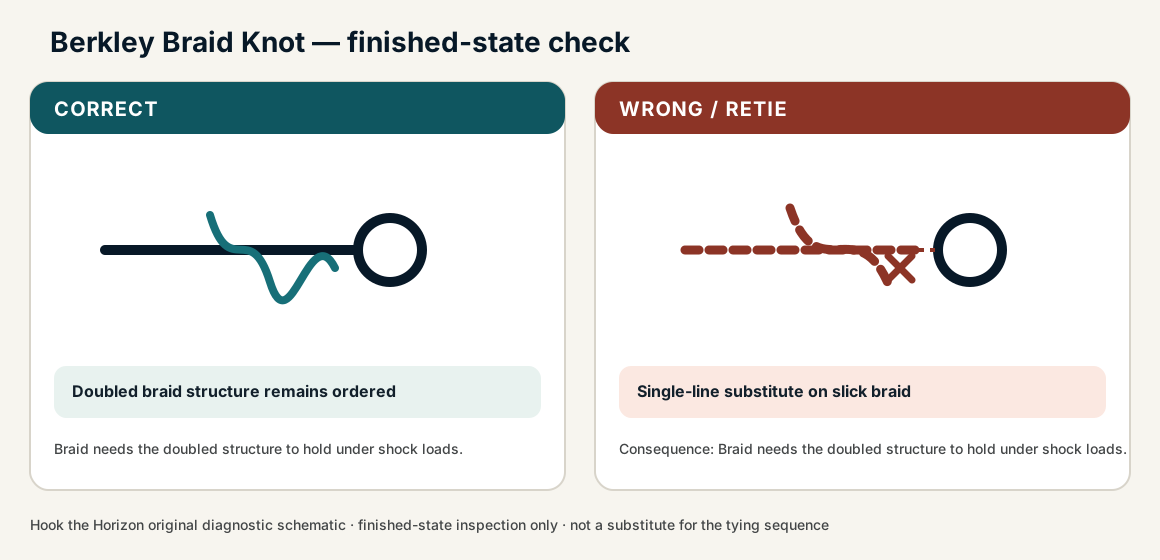
Finished check failed — Single-line substitute on slick braid
Check
- ?Doubled braid structure remains ordered
- ?Wraps seat without springing open
- ?Tag controlled after draw
Then
- →Retie. Braid needs the doubled structure to hold under shock loads.
Uni wraps around one braid strand only
Check
- ?A different knot — doubled braid will walk
- ?Inspect step 02
Then
- →Retie. Do not dress a defective structure and call it seated.
Barrel closed before it reached the eye
Check
- ?Walks under load on slick superline
- ?Inspect step 03
Then
- →Retie. Do not dress a defective structure and call it seated.
Eye too small for doubled braid
Check
- ?Frays at the eye or never seats
- ?Inspect step 01
Then
- →Retie. Do not dress a defective structure and call it seated.
Same failure class, different geometry. Open the plates — Diagnose still starts from the symptom.
What holds it
- ·The eye is hardware. The knot is an open tangle around that eye. Ends stay ends.
- ·Seating (wet set, even wraps, tag orientation) is the mechanical record already on the knot. Theory adds no extra rating.
What topology does not predict
- ·Trefoil / unknot classification does not apply to a Palomar or clinch.
- ·Fluoro glaze, pigtail slip and nick-at-the-guides are forensic, not topological.
- ·No strength percentage is computed here.
Not for
- ·A free-swing lure loop — use a non-slip loop family
- ·Using an invariant as a reason to keep a glazed terminal
- ·Tiny eyes that will not accept doubled braid
- ·When a simple Palomar already seats cleanly
Same pattern, different job
No sourced twin among these knots. Related knots stay on the Library card.
- Knot — practical vs mathematical (Wikipedia) — Closed-curve knot theory ignores friction. Practical knots are classified by function.
- Patil et al. — Topological mechanics of knots and tangles (Science, 2020) — Lab rods: simple topological counts correlate with stability. Not a field rating table.
- FishingKnots.com strength database (Berkley Braid band) — Recovered from the historical MODEL_SOURCES registry.
- Hook the Horizon — Berkley Braid Knot — Recovered from the same record’s historical Hook the Horizon resource URL.
- Next Level Angling — How to Tie a Berkley Braid Knot — Cited tying video already attached to this record.