Australian Plait
Doubled line · Jam
Does not pick a knot
This page does not pick a knot for you. DNA, molecules, quantum braids and vortices stay off Decide.
Finished structure
No drawing of this exact knot yet. The written steps are the reference.
Australian Plait — finished-state checks, on the shared reference layout
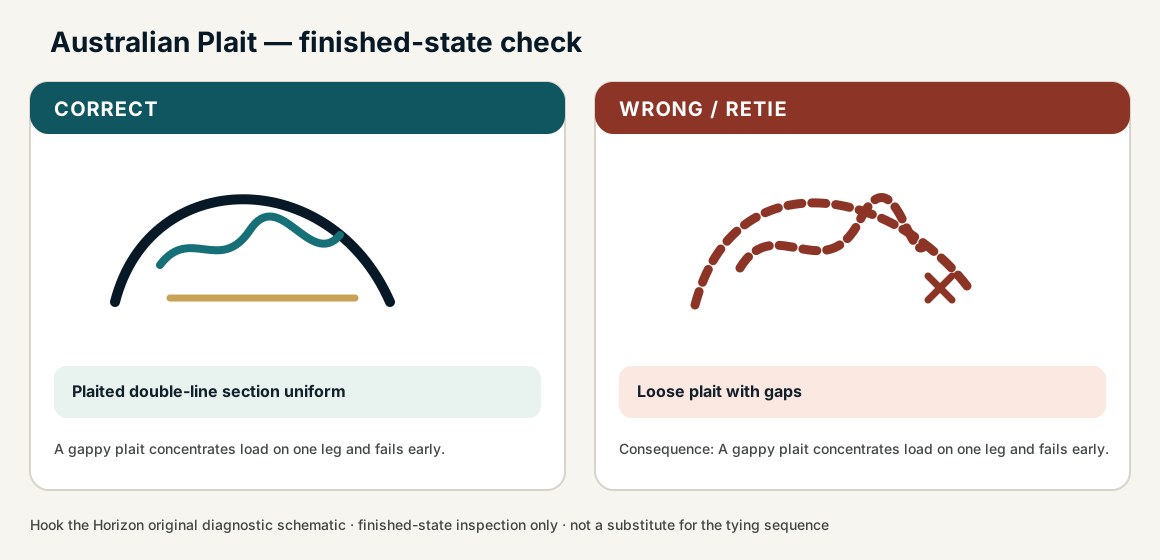
When this family fails, it fails as these. The recovered end still outranks the name.
A load-bearing loop of doubled line, locked so it cannot crawl back.
- !Twists or wraps not packed before the lock
- !Lock that crawls back into the double
- !Uneven legs — one side takes the shock
- !Plait left loose, so the loop strands slide and the double pulls out under load
- !Tag loop closed on nothing, so the plait unravels from its end
- !Finish tightened fast and dry, so it sits loose and the end of the plait opens
Loose plait that is not a double
Unravels in the guides
A plaited double is density plus a lock, not three loose strands · step 02
Too short a double to plait tightly
Cannot be locked; walks on the first load
The double has to be long enough to plait and lock · step 01
Incomplete lock at the plait end
Unlocks on the first load
An unlocked plait end is unfinished · step 03
Plait loosens under load
Check
- ?Plait density
- ?End lock
Then
- →Rebuild tighter
- →Use Bimini when conditions allow
Finished check failed — Loose plait with gaps
Check
- ?Plaited double-line section uniform
- ?Locking finish secure
- ?Legs share load
Then
- →Retie. A gappy plait concentrates load on one leg and fails early.
Loose plait that is not a double
Check
- ?Unravels in the guides
- ?Inspect step 02
Then
- →Retie. Do not dress a defective structure and call it seated.
Too short a double to plait tightly
Check
- ?Cannot be locked; walks on the first load
- ?Inspect step 01
Then
- →Retie. Do not dress a defective structure and call it seated.
Incomplete lock at the plait end
Check
- ?Unlocks on the first load
- ?Inspect step 03
Then
- →Retie. Do not dress a defective structure and call it seated.
Same failure class, different geometry. Open the plates — Diagnose still starts from the symptom.
What holds it
- ·A double-line is a made pair: twist, hitch or plait, then an end lock. The lock is the knot; the pair is the product.
- ·If the lock opens, you no longer have a double. That is a Diagnose story (double-line unravelled), not a change of mathematical type.
What topology does not predict
- ·Bimini wrap count is a cited procedure, not a Jones degree.
- ·Shock-load behaviour of the pair is material and construction. Unknown stays unknown here.
- ·No IGFA or tournament rule is inferred.
Not for
- ·A single-line terminal to a hook eye
- ·Calling an unlocked plait a finished double
- ·Quick bankside reties
- ·Beginners without practice
Same pattern, different job
No sourced twin among these knots. Related knots stay on the Library card.
- Knot — practical vs mathematical (Wikipedia) — Closed-curve knot theory ignores friction. Practical knots are classified by function.
- Patil et al. — Topological mechanics of knots and tangles (Science, 2020) — Lab rods: simple topological counts correlate with stability. Not a field rating table.
- NetKnots — Australian Plait
- Hook the Horizon — Australian Plait — Recovered from the same record’s historical Hook the Horizon resource URL.
- Club Marine TV — How to tie a plaited double knot with Paul Worsteling — Cited tying video already attached to this record.