Uni Snell Knot
Wrap stack · Constriction
Does not pick a knot
This page does not pick a knot for you. DNA, molecules, quantum braids and vortices stay off Decide.
Finished structure
No drawing of this exact knot yet. The written steps are the reference.
Uni Snell Knot — finished-state checks, on the shared reference layout
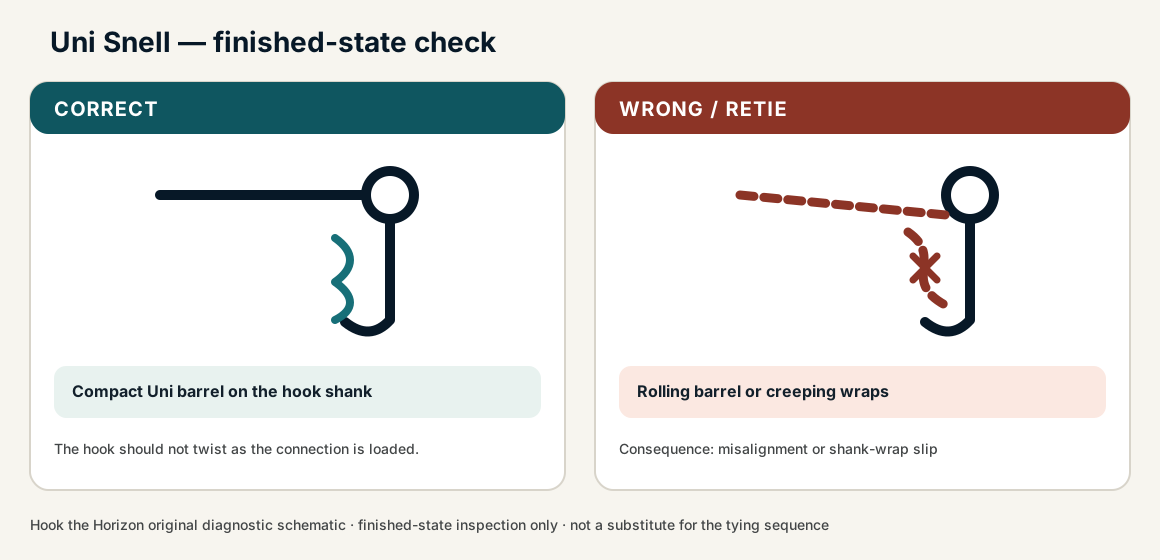
When this family fails, it fails as these. The recovered end still outranks the name.
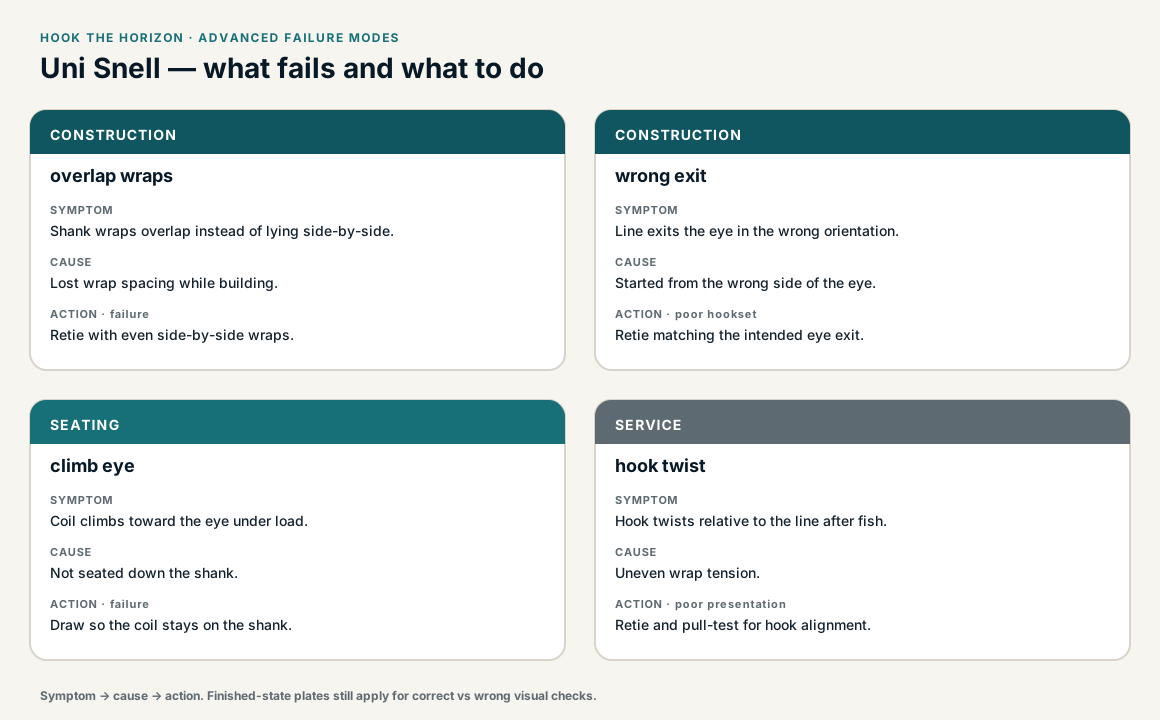
Uni Snell Knot — what fails and what to do
Wraps on the shank that capture the eye; the hook is the hardware.
- !Wraps walked off the shank
- !Eye never captured — the snell is a clinch in disguise
- !Bait loop closed, or the hair not trapped
- !A turn missed the shank, so the snell slides along it
- !Barrel tightened partway down the shank, so the hook pulls at an angle
- !A crossed turn that does not bed down, which slips or breaks under load
- !Cinched quickly while dry, which can burn the leader
Barrel around the standing line only
That is a Uni, not a snell — the hook rotates
A Uni snell wraps the shank, then compresses to the eye · step 02
Finish mid-shank
Hook rotates off-axis under load
The barrel must compress all the way to the eye · step 03
No shank to snell
Wrong family — pick a terminal that uses the eye
A snell needs a shank; an eyed-only hook is a different job · step 01
Barrel slides on shank
Check
- ?Even barrel on shank
Then
- →Retie under tension
Shank wraps overlap instead of lying side-by-side.
Check
- ?Look for: Shank wraps overlap instead of lying side-by-side.
Then
- →Retie with even side-by-side wraps.
Line exits the eye in the wrong orientation.
Check
- ?Look for: Line exits the eye in the wrong orientation.
Then
- →Retie matching the intended eye exit.
Coil climbs toward the eye under load.
Check
- ?Look for: Coil climbs toward the eye under load.
Then
- →Draw so the coil stays on the shank.
Hook twists relative to the line after fish.
Check
- ?Look for: Hook twists relative to the line after fish.
Then
- →Retie and pull-test for hook alignment.
Finished check failed — barrel rolls around the shank
Check
- ?Uni barrel lies cleanly on the hook shank
- ?line exits through the eye in the intended direction
- ?wraps remain compact during a load test
Then
- →Retie. misalignment or shank-wrap slip.
Barrel around the standing line only
Check
- ?That is a Uni, not a snell — the hook rotates
- ?Inspect step 02
Then
- →Retie. Do not dress a defective structure and call it seated.
Finish mid-shank
Check
- ?Hook rotates off-axis under load
- ?Inspect step 03
Then
- →Retie. Do not dress a defective structure and call it seated.
No shank to snell
Check
- ?Wrong family — pick a terminal that uses the eye
- ?Inspect step 01
Then
- →Retie. Do not dress a defective structure and call it seated.
Same failure class, different geometry. Open the plates — Diagnose still starts from the symptom.
What holds it
- ·A snell is a shank column. On-axis pull is the job. The hook is the object the wraps bear on.
- ·If the barrel sits mid-shank the hook rotates. That is geometry, not a change of knot type in the mathematical sense.
What topology does not predict
- ·Closed-curve knot theory has nothing to say about shank alignment.
- ·Bait-loop size (egg loop) is a set dimension, not an invariant.
- ·No rating is invented for circle vs J-hook.
Not for
- ·Ring-eye-only terminals with no shank to wrap — unless the record says otherwise
- ·Treating a floating Uni on the standing line as a finished snell
- ·When a traditional snell is already automatic and preferred
- ·Ring-eye-only hooks with no shank to wrap
Same pattern, different job
No sourced twin among these knots. Related knots stay on the Library card.
- Knot — practical vs mathematical (Wikipedia) — Closed-curve knot theory ignores friction. Practical knots are classified by function.
- Patil et al. — Topological mechanics of knots and tangles (Science, 2020) — Lab rods: simple topological counts correlate with stability. Not a field rating table.
- NetKnots — Snell Knot, Uni Version
- Hook the Horizon — Uni Snell — Recovered from the same record’s historical Hook the Horizon resource URL.
- Saltwater Experience - Tom Rowland Podcast — The Uni Knot Snell - Learn to Tie! — Cited tying video already attached to this record.