Loop-to-Loop Connection
Interlock
Does not pick a knot
This page does not pick a knot for you. DNA, molecules, quantum braids and vortices stay off Decide.
Finished structure
No drawing of this exact knot yet. The written steps are the reference.
Loop-to-Loop Connection — finished-state checks, on the shared reference layout
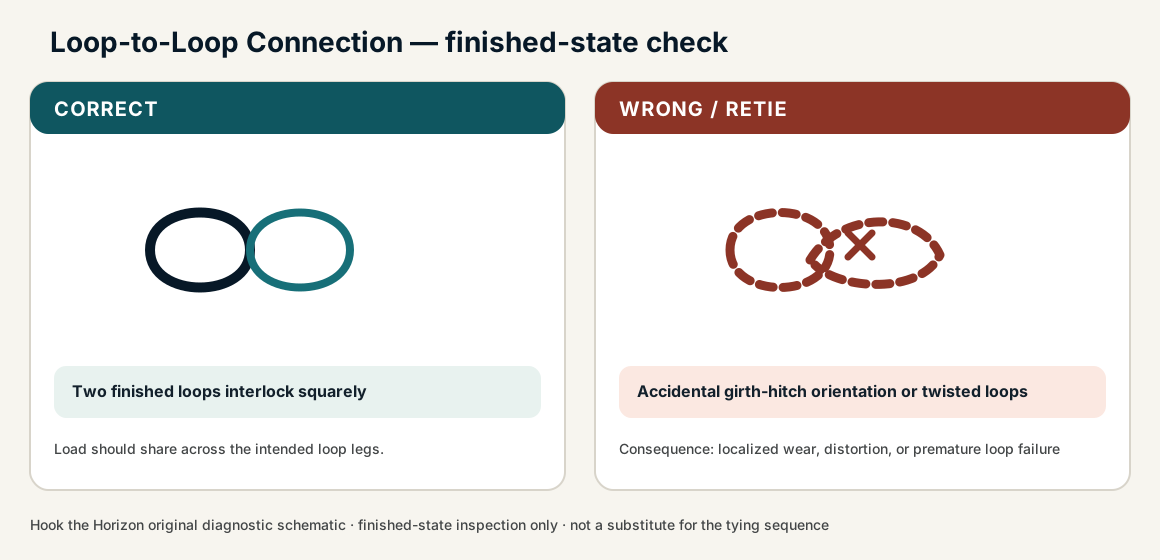
When this family fails, it fails as these. The recovered end still outranks the name.
Loop-to-Loop Connection — what fails and what to do
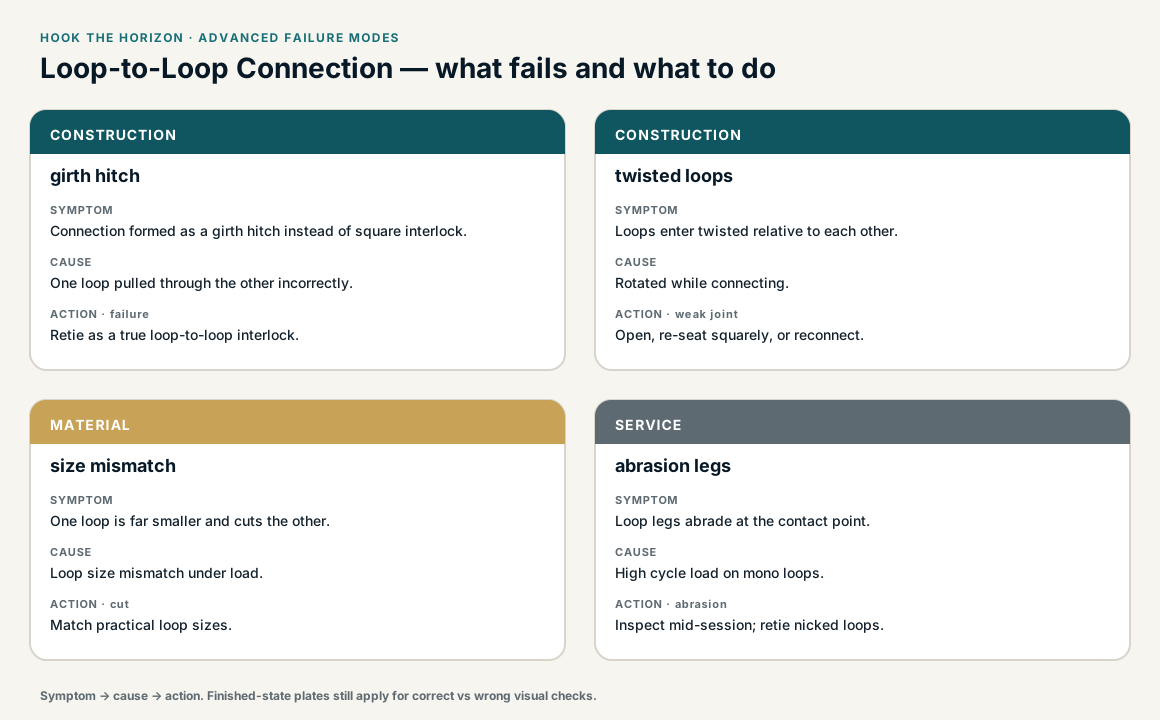
A loop that either stands as a dropper or handshake onto another loop.
- !Dropper loop collapsed into an overhand
- !Handshake twisted so one loop saws the other
- !Loop sized after it was already loaded
- !The loops finish as a girth hitch, putting the pull on one bend so it can cut the gripped loop
- !Either loop has cracked coating or a frayed core where it bends
- !The knot or join that forms either loop is loose or damaged
Assembled as a girth hitch
One loop cinches and cuts the other
Matching U-shapes only — a girth is a failed handshake · step 02
Oversized leader loop, or only the tippet through
Unfinished handshake; coating crushes
Both loops must pass fully and sit as a handshake · step 03
Factory loop already damaged
Crushed coating is a cut-off, not a retie of the handshake
Replace the loop; do not ‘fix’ a girth by pulling harder · step 01
One loop cinches and cuts the other
Check
- ?Matching U-shapes
- ?Neither loop collapsed
Then
- →Undo and reassemble as a handshake
- →Replace a damaged factory loop
Connection formed as a girth hitch instead of square interlock.
Check
- ?Look for: Connection formed as a girth hitch instead of square interlock.
Then
- →Retie as a true loop-to-loop interlock.
Loops enter twisted relative to each other.
Check
- ?Look for: Loops enter twisted relative to each other.
Then
- →Open, re-seat squarely, or reconnect.
One loop is far smaller and cuts the other.
Check
- ?Look for: One loop is far smaller and cuts the other.
Then
- →Match practical loop sizes.
Loop legs abrade at the contact point.
Check
- ?Look for: Loop legs abrade at the contact point.
Then
- →Inspect mid-session; retie nicked loops.
Finished check failed — one loop collapses into an accidental girth-hitch orientation
Check
- ?two finished loops interlock squarely
- ?load is shared across the intended loop legs
- ?connection can be separated without visible twist damage
Then
- →Retie. localized wear, distortion, or premature loop failure.
Assembled as a girth hitch
Check
- ?One loop cinches and cuts the other
- ?Inspect step 02
Then
- →Retie. Do not dress a defective structure and call it seated.
Oversized leader loop, or only the tippet through
Check
- ?Unfinished handshake; coating crushes
- ?Inspect step 03
Then
- →Retie. Do not dress a defective structure and call it seated.
Factory loop already damaged
Check
- ?Crushed coating is a cut-off, not a retie of the handshake
- ?Inspect step 01
Then
- →Retie. Do not dress a defective structure and call it seated.
Same failure class, different geometry. Open the plates — Diagnose still starts from the symptom.
What holds it
- ·A fixed loop is a standing eye. The collar or figure-eight body must survive a straight pull without becoming a noose.
- ·Bowline and sheet bend are the same crossing pattern under different load. That identity is seamanship, not a reason for Decide to swap one for the other.
What topology does not predict
- ·Fixed vs slipped is a load-path question. Invariants do not choose bowline over figure-eight.
- ·Ring-loading and slack-shaking failure are physical. Topology does not grade them.
- ·No UIAA or manufacturer number is inferred here.
Not for
- ·A lure that must swing on a non-slip loop — this standing eye is a different job
- ·Letting a climbing identity pick your fishing knot
- ·Damaged factory loops
- ·When lowest profile matters (Nail / Needle)
Same pattern, different job
No sourced twin among these knots. Related knots stay on the Library card.
- Bowline — seamanship identity with the sheet bend (Wikipedia) — Standard identity: bowline is the sheet-bend tangle with the loop loaded.
- Knot — practical vs mathematical (Wikipedia) — Closed-curve knot theory ignores friction. Practical knots are classified by function.
- Patil et al. — Topological mechanics of knots and tangles (Science, 2020) — Lab rods: simple topological counts correlate with stability. Not a field rating table.
- NetKnots — Loop-to-Loop
- Hook the Horizon — Loop-to-Loop Connection — Recovered from the same record’s historical Hook the Horizon resource URL.
- NetKnots fishing knot references — Recovered from this record’s historical modelSourceId registry.
- Murray's Fly Shop — Quick Fly Fishing Tip: Loop to Loop Leader Fly Line Connection — Cited tying video already attached to this record.