Eye Crosser Knot
Constriction · Wrap stack
Does not pick a knot
This page does not pick a knot for you. DNA, molecules, quantum braids and vortices stay off Decide.
Finished structure
No drawing of this exact knot yet. The written steps are the reference.
Eye Crosser Knot — finished-state checks, on the shared reference layout
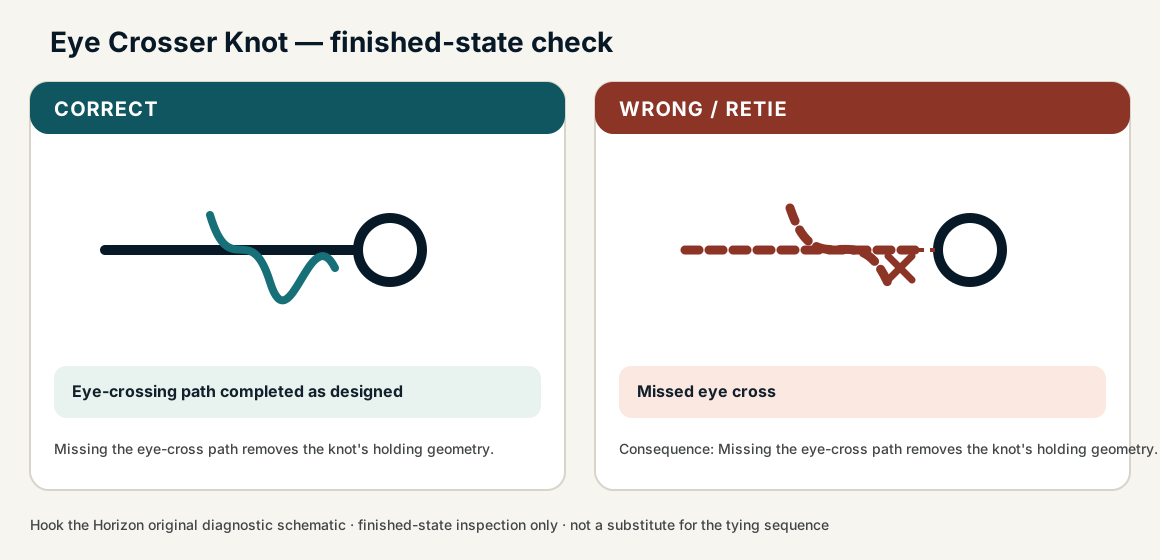
When this family fails, it fails as these. The recovered end still outranks the name.
Braid at the eye with extra passes so the slick line cannot slip.
- !Passes never crossed through the eye
- !Tag not locked after the extra braid passes
- !Used on a small eye that cannot take the bulk
- !Wraps around the standing line only, so they slide loose when the tag is pulled
- !Tightened dry or not bedded down, so the knot moves along the line under load
- !Second turn riding over the first, so it is pinched against the eye when loaded
- !Tag left too short, so it slips out as the knot is tightened
Crossed strands in the eye
Scores the line at the first hard turn
Two clean eye passes, then the lock around the parallel pair · step 02
Eye too small for two passes
Will not seat, or cuts at the eye
Hardware must accept the doubled pass or this is the wrong terminal · step 01
Lock tied on the wrong side
A slip, not an Eye Crosser
The lock around the parallel strands is the finish · step 03
Knot will not seat or scores at the eye
Check
- ?Two parallel strands in the eye
- ?Lock butted to the eye
Then
- →Retie on larger hardware
- →Use Palomar or Uni instead
Finished check failed — Missed eye cross
Check
- ?Eye-crossing path completed as designed
- ?Seated without open loops
- ?Tag exit correct
Then
- →Retie. Missing the eye-cross path removes the knot's holding geometry.
Crossed strands in the eye
Check
- ?Scores the line at the first hard turn
- ?Inspect step 02
Then
- →Retie. Do not dress a defective structure and call it seated.
Eye too small for two passes
Check
- ?Will not seat, or cuts at the eye
- ?Inspect step 01
Then
- →Retie. Do not dress a defective structure and call it seated.
Lock tied on the wrong side
Check
- ?A slip, not an Eye Crosser
- ?Inspect step 03
Then
- →Retie. Do not dress a defective structure and call it seated.
Same failure class, different geometry. Open the plates — Diagnose still starts from the symptom.
What holds it
- ·The eye is hardware. The knot is an open tangle around that eye. Ends stay ends.
- ·Seating (wet set, even wraps, tag orientation) is the mechanical record already on the knot. Theory adds no extra rating.
What topology does not predict
- ·Trefoil / unknot classification does not apply to a Palomar or clinch.
- ·Fluoro glaze, pigtail slip and nick-at-the-guides are forensic, not topological.
- ·No strength percentage is computed here.
Not for
- ·A free-swing lure loop — use a non-slip loop family
- ·Using an invariant as a reason to keep a glazed terminal
- ·Tiny fly eyes
- ·Crowded hardware where a single-pass Uni or Palomar already fits
Same pattern, different job
No sourced twin among these knots. Related knots stay on the Library card.
- Knot — practical vs mathematical (Wikipedia) — Closed-curve knot theory ignores friction. Practical knots are classified by function.
- Patil et al. — Topological mechanics of knots and tangles (Science, 2020) — Lab rods: simple topological counts correlate with stability. Not a field rating table.
- Take Me Fishing — Eye Crosser Knot
- Hook the Horizon — Eye Crosser Knot — Recovered from the same record’s historical Hook the Horizon resource URL.
- Take Me Fishing — How to Tie the Eye Crosser Knot | Fishing Knots — Cited tying video already attached to this record.