Dropper Loop
Interlock
Does not pick a knot
This page does not pick a knot for you. DNA, molecules, quantum braids and vortices stay off Decide.
Twists either side of a mid-line opening; the loop stands perpendicular to the main line.
Finished structure
Twists either side of a mid-line opening; the loop stands perpendicular to the main line.
Dropper Loop — finished-state checks, on the shared reference layout
When this family fails, it fails as these. The recovered end still outranks the name.
A loop that either stands as a dropper or handshake onto another loop.
- !Dropper loop collapsed into an overhand
- !Handshake twisted so one loop saws the other
- !Loop sized after it was already loaded
- !Loop released before tightening, so it slides back out through the opening
- !Loop pushed through off centre, so it pulls out or the knot closes lopsided
- !Ends snatched or pulled unevenly, so the loop leans along the line instead of standing out
- !Loop tied too long, so it fouls and twists around the main line
Dropper lock incomplete — loop collapses
Dropper fails and the fly is gone
The pass-through lock is the dropper; a collapse is unfinished · step 03
Twists not even — weakens the main
The mainline is the failure, not the dropper
Neat twists preserve mainline strength around the loop · step 02
Pass-through never completed
Not a dropper — a malformed overhand on the main
The pass-through must complete before any load · step 03
Loop lies along the main line instead of standing out
Check
- ?Count twists either side of the loop base
Then
- →Retie with symmetrical twists and a centred pass-through
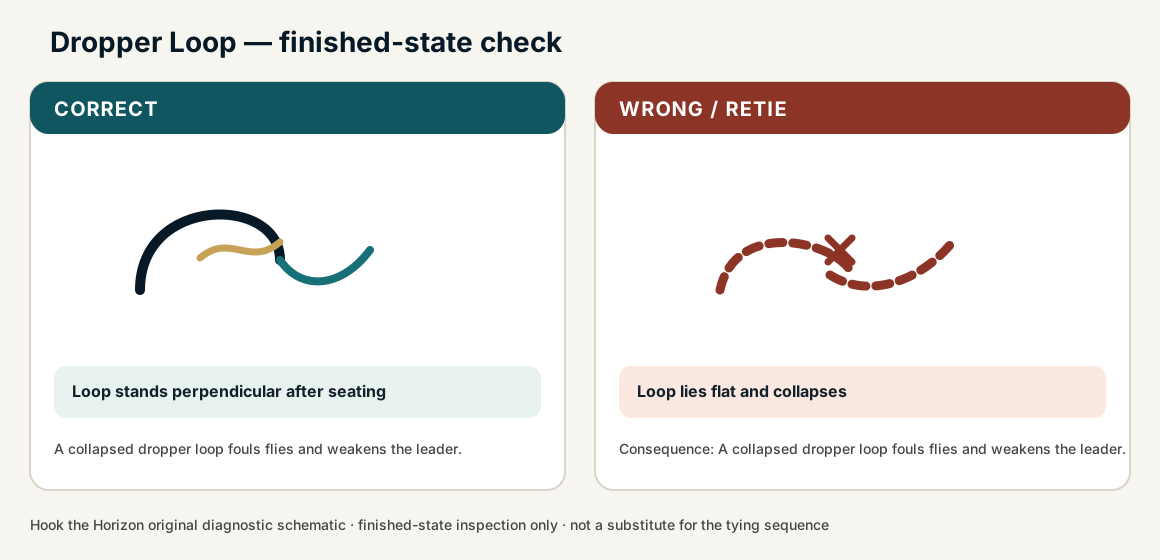
Finished check failed — Loop lies flat and collapses
Check
- ?Loop stands perpendicular after seating
- ?Wraps ordered around the standing line
- ?Loop size matches intended dropper length
Then
- →Retie. A collapsed dropper loop fouls flies and weakens the leader.
Dropper lock incomplete — loop collapses
Check
- ?Dropper fails and the fly is gone
- ?Inspect step 03
Then
- →Retie. Do not dress a defective structure and call it seated.
Twists not even — weakens the main
Check
- ?The mainline is the failure, not the dropper
- ?Inspect step 02
Then
- →Retie. Do not dress a defective structure and call it seated.
Pass-through never completed
Check
- ?Not a dropper — a malformed overhand on the main
- ?Inspect step 03
Then
- →Retie. Do not dress a defective structure and call it seated.
Same failure class, different geometry. Open the plates — Diagnose still starts from the symptom.
What holds it
- ·A fixed loop is a standing eye. The collar or figure-eight body must survive a straight pull without becoming a noose.
- ·Bowline and sheet bend are the same crossing pattern under different load. That identity is seamanship, not a reason for Decide to swap one for the other.
What topology does not predict
- ·Fixed vs slipped is a load-path question. Invariants do not choose bowline over figure-eight.
- ·Ring-loading and slack-shaking failure are physical. Topology does not grade them.
- ·No UIAA or manufacturer number is inferred here.
Not for
- ·A lure that must swing on a non-slip loop — this standing eye is a different job
- ·Letting a climbing identity pick your fishing knot
- ·Terminal strength jobs
- ·Braid, which will not hold the twist column
Same pattern, different job
No sourced twin among these knots. Related knots stay on the Library card.
- Bowline — seamanship identity with the sheet bend (Wikipedia) — Standard identity: bowline is the sheet-bend tangle with the loop loaded.
- Knot — practical vs mathematical (Wikipedia) — Closed-curve knot theory ignores friction. Practical knots are classified by function.
- Patil et al. — Topological mechanics of knots and tangles (Science, 2020) — Lab rods: simple topological counts correlate with stability. Not a field rating table.
- Animated Knots — Dropper Loop
- Dieter Melhorn Fishing — How to tie the Dropper Loop — Cited tying video already attached to this record.