Bobber Stop Knot
Friction on hardware
Does not pick a knot
This page does not pick a knot for you. DNA, molecules, quantum braids and vortices stay off Decide.
Finished structure
Drawn from a rope model of this knot: which strand passes over which comes from where the rope actually lies.
Bobber Stop Knot — finished-state checks, on the shared reference layout
When this family fails, it fails as these. The recovered end still outranks the name.
A grip set on the main line to hold a position, carrying no fish load.
- !Too few wraps for a slick line, so it creeps under casting
- !Drawn down hard enough to flatten the main line — a weak point built on purpose
- !Tags trimmed flush, so it jams in a guide and can no longer be slid
- !Too few turns, so the stop creeps along the line over a few casts
- !Pulled down hard enough to flatten or kink the main line under it
- !Tags cut flush, so a stop that loosens cannot be snugged up and catches in a guide
- !Turns laid over each other instead of side by side
Stop creeps along the main line
The bait fishes deeper every cast and you stop knowing where it is
Grip comes from wrap count and stopper material, not from how hard it is pulled. · step 02
Main line deformed under the stop
A weak spot built deliberately into the middle of the main line
A stop pulled past snug crushes mono; the flat spot is where the line will break. · step 03
Tags trimmed flush so the stop jams in a guide
Catches on the cast, and cannot be slid to change depth
The long tags are what let it fold through a guide and what you grip to move it. · step 04
The float creeps deeper over a few casts
Check
- ?Mark the line and watch whether the stop has moved after ten casts
Then
- →Add a wrap
- →Switch to Dacron backing as the stopper material
The stop catches in a guide on the cast or the retrieve
Check
- ?Draw the stop through the tip guide by hand
Then
- →Retie leaving longer tags
- →Re-dress the wraps so they lie side by side
The main line shows a flat spot or a curl where the stop has been sitting
Check
- ?Slide the stop and run the line between your fingers
Then
- →Cut back past the marked section and re-rig
- →Set the next stop snug rather than crushed
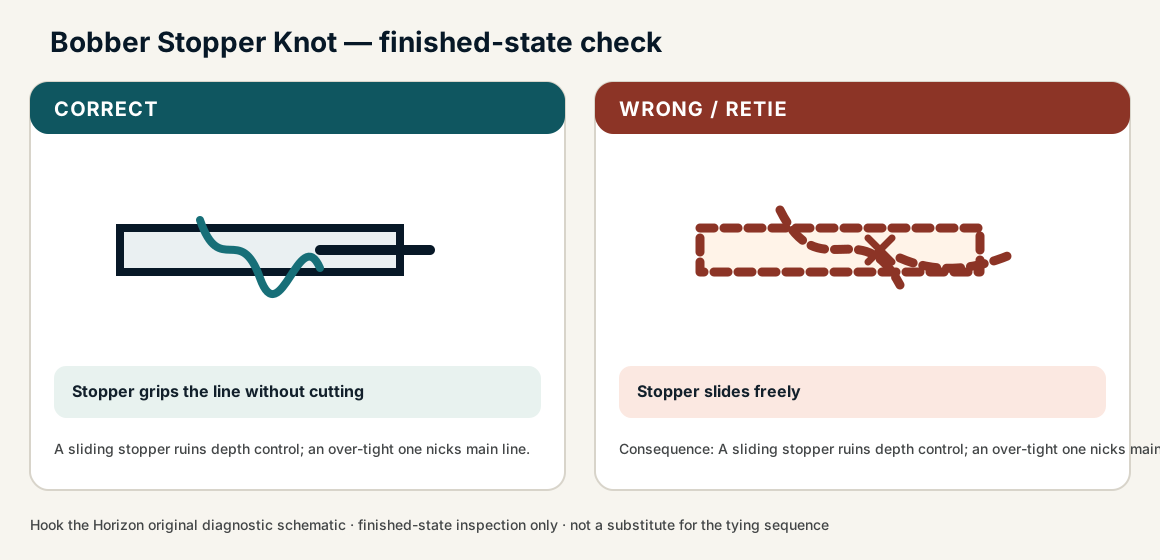
Finished check failed — Stopper slides freely
Check
- ?Stopper grips the line without cutting
- ?Position holds after cast pressure
- ?Coils neat and short
Then
- →Retie. A sliding stopper ruins depth control; an over-tight one nicks main line.
Stop creeps along the main line
Check
- ?The bait fishes deeper every cast and you stop knowing where it is
- ?Inspect step 02
Then
- →Retie. Do not dress a defective structure and call it seated.
Main line deformed under the stop
Check
- ?A weak spot built deliberately into the middle of the main line
- ?Inspect step 03
Then
- →Retie. Do not dress a defective structure and call it seated.
Tags trimmed flush so the stop jams in a guide
Check
- ?Catches on the cast, and cannot be slid to change depth
- ?Inspect step 04
Then
- →Retie. Do not dress a defective structure and call it seated.
What holds it
- ·A hitch is object-dependent. Remove the spar, cleat, ring or pile and the structure is usually the unknot.
- ·Bayman / Maddocks–Keller describe a no-slip regime from wrap count and friction. The prediction is approximate, and only for hitches.
What topology does not predict
- ·Closed-loop knot invariants (Jones, Alexander) do not say whether a clove hitch will walk on a smooth spar.
- ·No manufacturer working load is implied by wrap count.
- ·Wet, iced, or HMPE covers change friction — topology is silent.
Not for
- ·Joining two free rope ends — that is a bend
- ·A standing loop that must survive after the object is gone
- ·Carrying load — it is a position stop, not a connection
- ·Leaving on the line for weeks, where it will bed a mark into mono
Same pattern, different job
No sourced twin among these knots. Related knots stay on the Library card.
- Crowell — The physics of knots (Bayman / Maddocks–Keller) — Bayman 1977 hitch theory; Maddocks & Keller 1987 extension. No equally good general theory for all knots.
- Sano et al. — Inner workings of the clove hitch (Extreme Mechanics Letters, 2022) — Elastic rod on a rigid cylinder. Empirical hitch mechanics.
- Knot — practical vs mathematical (Wikipedia) — Closed-curve knot theory ignores friction. Practical knots are classified by function.
- NetKnots — Bobber Stopper Knot
- Take Me Fishing — How to tie the bobber stopper knot
- NetKnots fishing knot references — Recovered from this record’s historical modelSourceId registry.
- Show Me the Hawgs — How to Tie a Bobber Stop Knot (and One Extra Tip) — Cited tying video already attached to this record.