Haywire Twist
Constriction · Wrap stack
Does not pick a knot
This page does not pick a knot for you. DNA, molecules, quantum braids and vortices stay off Decide.
Finished structure
No drawing of this exact knot yet. The written steps are the reference.
Haywire Twist — finished-state checks, on the shared reference layout
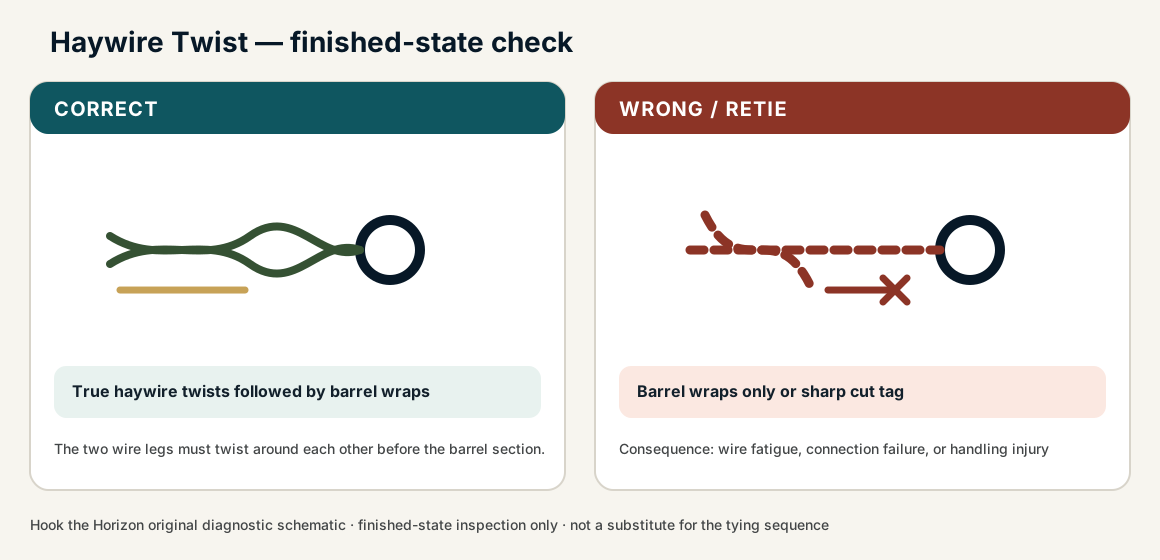
When this family fails, it fails as these. The recovered end still outranks the name.
Haywire Twist — what fails and what to do
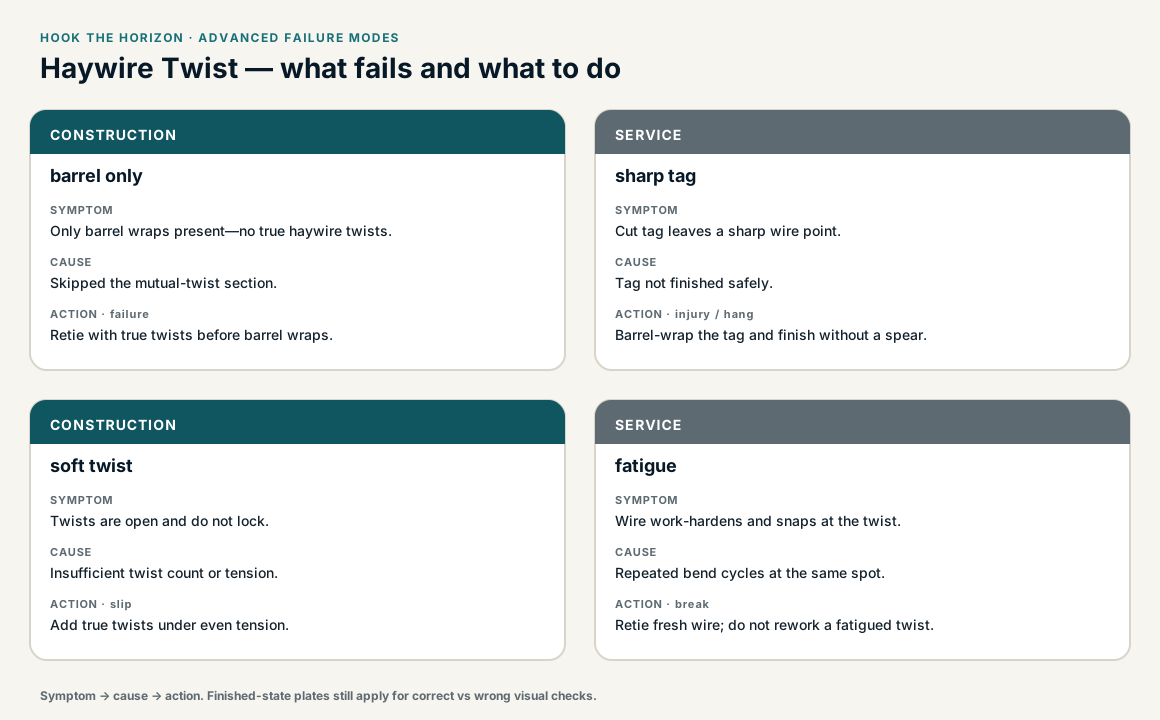
Single-strand wire held by its own permanent set, not by friction.
- !Strands crossed too shallow, so one wire wraps a straight one and pulls out
- !Too few symmetrical crossings before the barrel wraps start
- !Tag cut instead of broken, leaving a spur that finds hands and leader
- !Kinked wire reused — single strand fails at a kink with no warning
- !One strand runs straight with the other coiled around it, so the coil can slide off and pull out under load
- !Fewer than three and a half twists were made before the barrel wraps
- !The barrel wraps are gapped or spread out, leaving the twists free to unwind
- !The wire is kinked, from tying or from an earlier fish. Kinked single-strand wire is weak at the kink.
One strand wrapped around a straight one
Pulls straight under load and the leader is gone with no warning
A haywire holds because both strands spiral about a common centre. A wrap around a straight strand has nothing gripping it and simply unwinds. · step 02
Fewer than three and a half symmetrical twists
Not enough shared spiral to carry the load into the barrel wraps
The symmetrical section, not the barrel wraps, is what takes the strain. · step 02
Gapped or loose barrel wraps
The tag can work back and the twist can open
The barrel wraps close the twist; gaps let it breathe under cyclic load. · step 03
Cut tag leaving a spur
Catches hands, nets and leader; a reliable source of cuts
Rocking the tag until it fatigues parts the wire flush; cutters cannot. · step 04
Kink in the wire
Single-strand wire fails at a kink without warning
A kink is a permanent stress riser; the wire has already been damaged there.
One wire is straight and the other is wound around it
Check
- ?Look down the twist — both strands should spiral around a common centre
- ?A straight strand running through the middle means it is not a haywire
Then
- →Cut the section off and rebuild; a wrapped haywire pulls straight under load
- →Start with the strands crossed at well over a right angle
A sharp spur of wire stands proud at the end of the barrel wraps
Check
- ?Run the connection through a cloth — a spur will catch
Then
- →Break the tag by rocking it so it parts flush
- →If already cut, rebuild rather than trying to dress the spur
The leader has a kink or a tight bend near the twist
Check
- ?Sight along the wire for any bend that does not fair out
Then
- →Discard the leader — single-strand wire fails at a kink and gives no warning
Only barrel wraps present—no true haywire twists.
Check
- ?Look for: Only barrel wraps present—no true haywire twists.
Then
- →Retie with true twists before barrel wraps.
Cut tag leaves a sharp wire point.
Check
- ?Look for: Cut tag leaves a sharp wire point.
Then
- →Barrel-wrap the tag and finish without a spear.
Twists are open and do not lock.
Check
- ?Look for: Twists are open and do not lock.
Then
- →Add true twists under even tension.
Wire work-hardens and snaps at the twist.
Check
- ?Look for: Wire work-hardens and snaps at the twist.
Then
- →Retie fresh wire; do not rework a fatigued twist.
Finished check failed — only barrel wraps are formed
Check
- ?true haywire twists precede barrel wraps
- ?wire strands rotate around each other rather than one strand merely wrapping the other
- ?tag is fatigue-broken cleanly rather than cut into a sharp burr
Then
- →Retie. wire fatigue, connection failure, or handling injury.
One strand wrapped around a straight one
Check
- ?Pulls straight under load and the leader is gone with no warning
- ?Inspect step 02
Then
- →Retie. Do not dress a defective structure and call it seated.
Fewer than three and a half symmetrical twists
Check
- ?Not enough shared spiral to carry the load into the barrel wraps
- ?Inspect step 02
Then
- →Retie. Do not dress a defective structure and call it seated.
Gapped or loose barrel wraps
Check
- ?The tag can work back and the twist can open
- ?Inspect step 03
Then
- →Retie. Do not dress a defective structure and call it seated.
What holds it
- ·The eye is hardware. The knot is an open tangle around that eye. Ends stay ends.
- ·Seating (wet set, even wraps, tag orientation) is the mechanical record already on the knot. Theory adds no extra rating.
What topology does not predict
- ·Trefoil / unknot classification does not apply to a Palomar or clinch.
- ·Fluoro glaze, pigtail slip and nick-at-the-guides are forensic, not topological.
- ·No strength percentage is computed here.
Not for
- ·A free-swing lure loop — use a non-slip loop family
- ·Using an invariant as a reason to keep a glazed terminal
- ·Mono, fluoro or braid — this is a wire-only structure
- ·Multi-strand cable, which wants a crimped sleeve instead
Same pattern, different job
No sourced twin among these knots. Related knots stay on the Library card.
- Knot — practical vs mathematical (Wikipedia) — Closed-curve knot theory ignores friction. Practical knots are classified by function.
- Patil et al. — Topological mechanics of knots and tangles (Science, 2020) — Lab rods: simple topological counts correlate with stability. Not a field rating table.
- NetKnots — Haywire Twist
- BD Outdoors — Haywire Twist for single strand wire leader
- NetKnots fishing knot references — Recovered from this record’s historical modelSourceId registry.
- ReelReports — How To Rig Wire Leader - The EASIEST Haywire Twist Tutorial — Cited tying video already attached to this record.